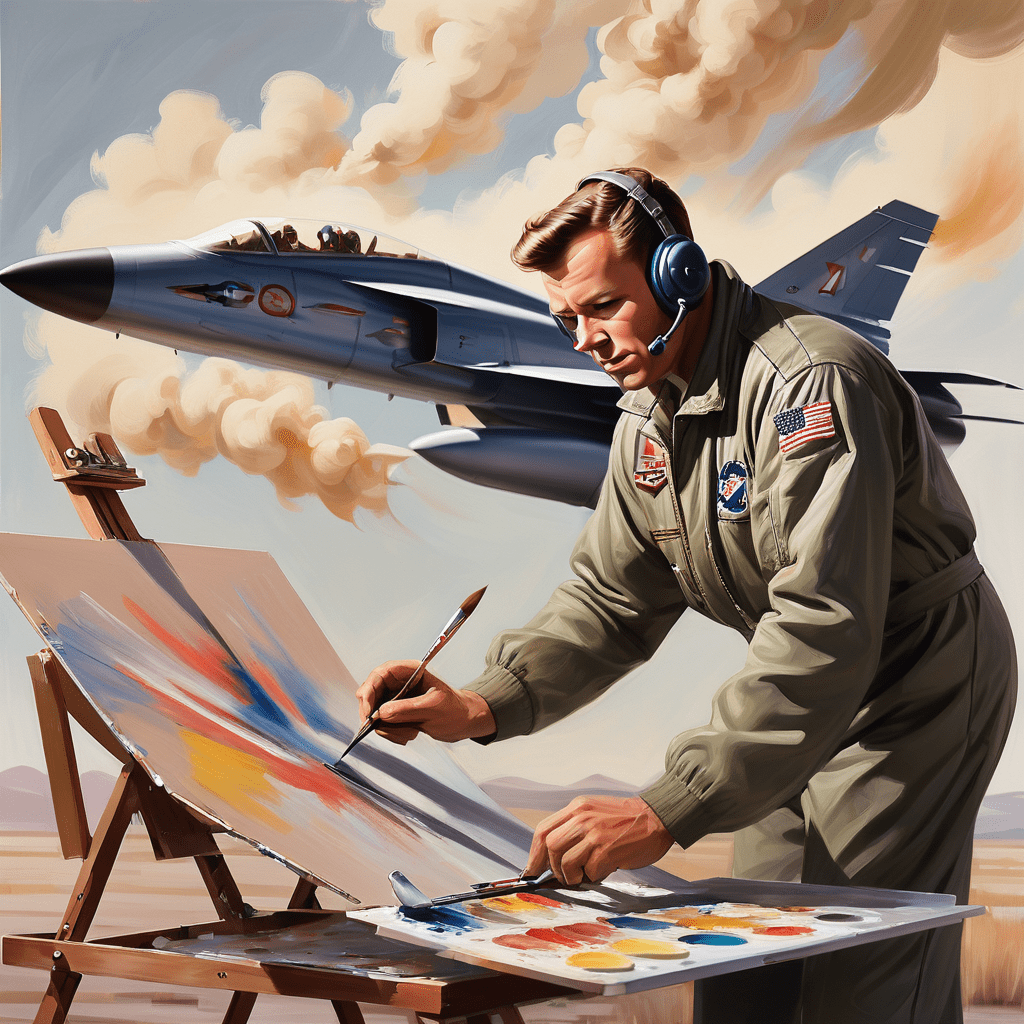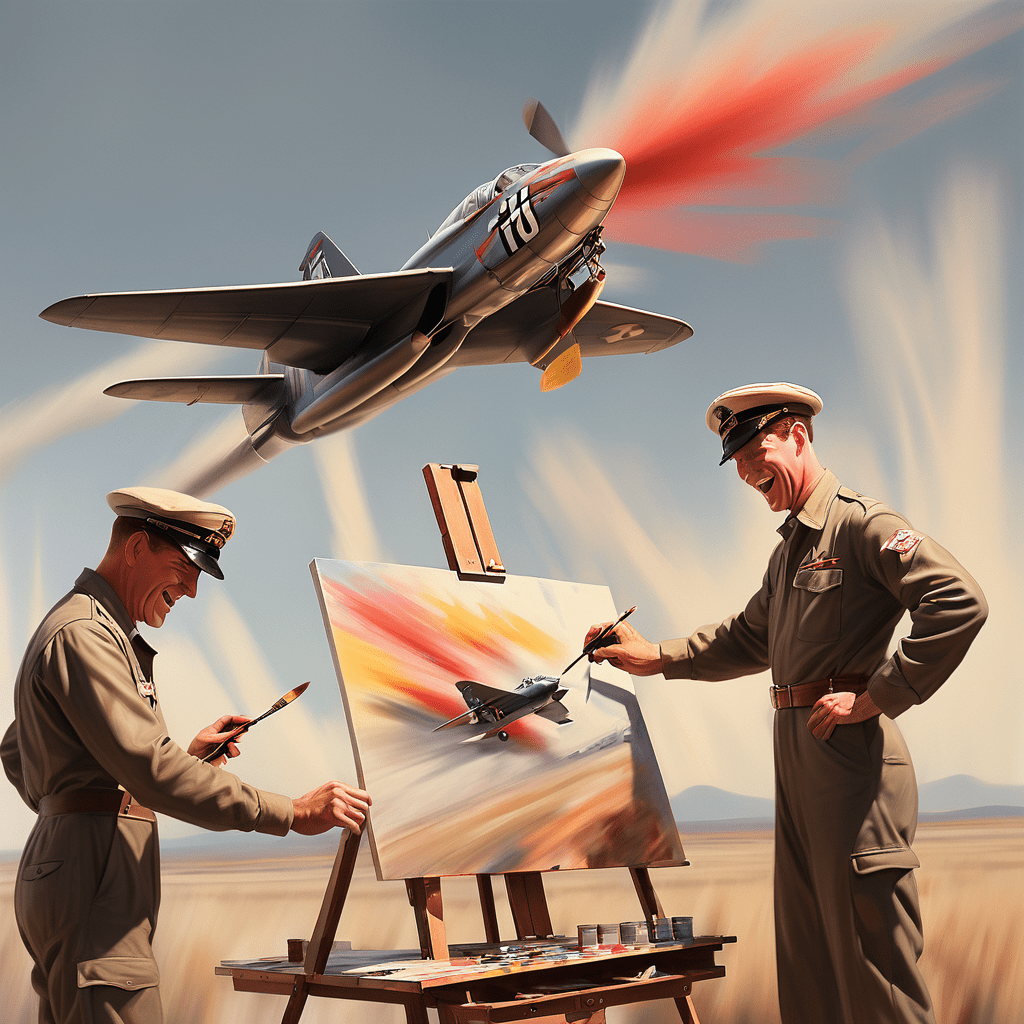
As is well known, AI is imminently poised to destroy all humans, mostly (it would seem) by producing pictures of people with too many fingers. Hush-Kit has already applied its own Turing Test by demanding AI produce pictures of some British aircraft and the results were undeniably spectacular. Will the electronic Leonardo da Vinci do better with mighty moments from US aviation history? Or will it be some geometry-defying insanity yet again? Obviously the latter, so let’s plunge in and have a merry time feeling superior to our soon-to-be robot overlords as they whip out the virtual Crayolas and do some colouring.
(Brief note on method: the aircraft name and/or the event in question was typed into two freely available image generation websites, Gencraft and Canva. I previously also used Da Vinci but those killjoys have imposed a paywall and I’m not going to shell out actual cash for this nonsense. I suggested a basic style (ie ‘oil painting’) on a few of them to vary things a bit. These are the genuine results).
1903: The Shite Brothers

Who’d have thought that the first flight of a powered, heavier-than-air flying machine would have been such a bleak experience? And who knew that the Wright Brothers had built a machine as large as a big house? Not me. To be fair to our arty AI pal, there’s a general air of Wright Flyer in there, but the vast size, scribbly bracing wires, mirage-like extra wing on the far side and overall vagueness detract somewhat. Also: where is the pilot? Is that him on the ground pointing at it? Nice touch to include a windsock too, although fixating on the windsock when the first ever aeroplane is taking off seems a bit perverse. Anyway, let’s see what it can come up with for the roaring twenties:
1927: Spirit of St Pooey

Charles Lindbergh triumphantly lands in Paris after the first solo crossing of the Atlantic! I always thought that Lindbergh landed at the airport rather than an avenue in the actual centre of Paris but hey, I wasn’t there. I am also quite surprised by the solemn lack of enthusiasm displayed by the crowd, but Electro-Monet has accurately grasped that France famously contains absolutely no women. The Ryan NYP that has conveyed Lucky Lindy to Gay Paree is both yellower and more asymmetrical than I remember, but it seems to be hovering there nicely, so that’s good. Are there two people in the cockpit? God knows: it’s all a bit vague in that area. Personally, though, I like the Tintin-esque vibe, and it looks a bit like a broadly viable aircraft (despite someone having stolen the propeller), which suggests perhaps that our artificial artiste is getting the hang of things. But then again…
1935: Crying Fortress
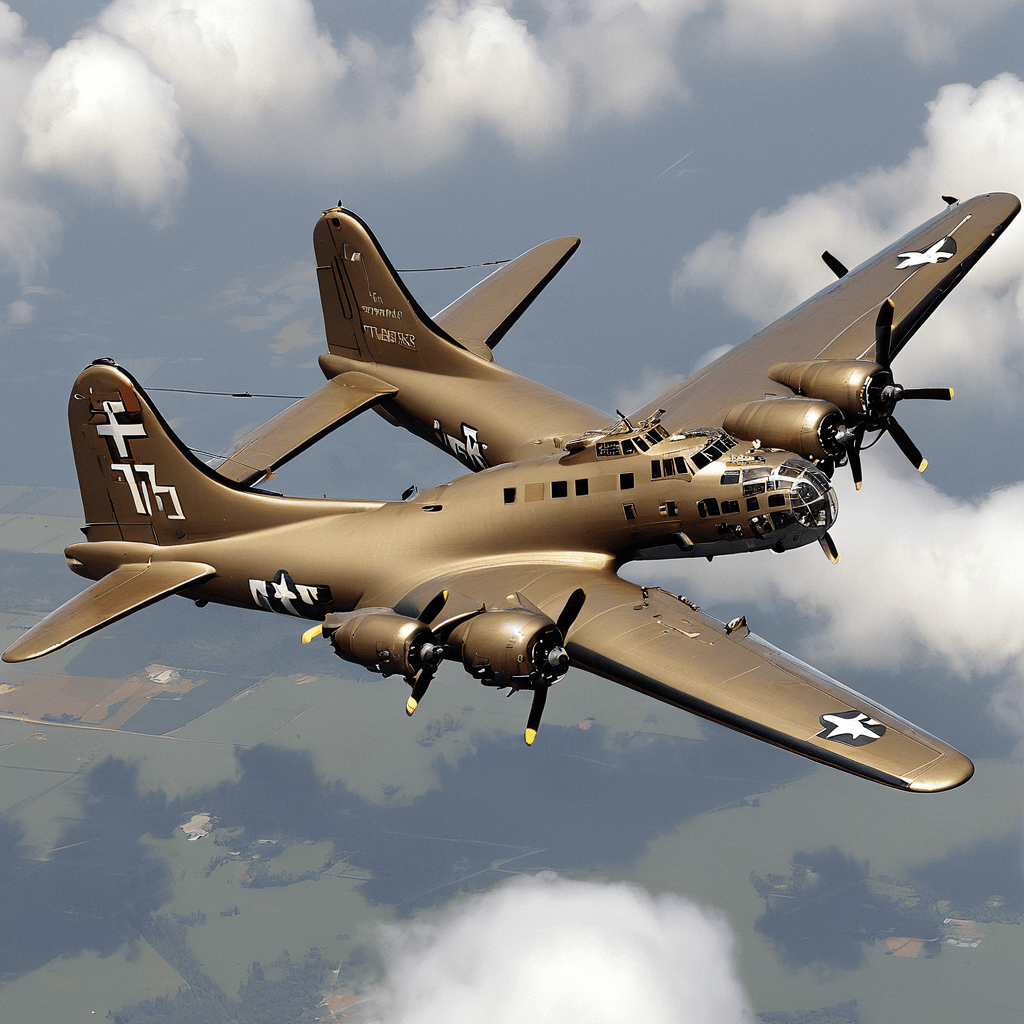
I mean, it made a pretty good stab at the markings. The really odd thing here, though, is that although this mess is just totally, hilariously wrong, it is, somehow, recognisable as a B-17 (or some of two B-17s). Imagine how much more entertaining both the 1990 feature film ‘Memphis Belle’ or the recent HBO series ‘Masters of the Air’ would have been had all the Eighth Air Force bombers looked like this. Alternatively, it is possible that Robot-Picasso has stumbled upon digital Cubism and is attempting to depict the Flying Fortress from all sides simultaneously (and doing a pretty good job).
1944: P-51D Mush-tang

How can something so dreadfully realised be simultaneously so instantly recognisable? It is June 1944 and this unusually tall and gappy P-51D Mustang has been painted with the black and white D-Day, um, ‘shapes’ under one of the wings. Mustang tailwheels were famous for not being able to keep up with the rest of the aircraft and pilots personalised their fighters by painting writing-like symbols on their noses. I assume that’s a drop tank under the fuselage, to allow this aircraft to fly to Berlin and back, but it might just as easily be a bin full of the crushed hopes and dreams of human artists.
1947: Lockweed Constipation

The war is over and non-stop scheduled transatlantic commercial airline services are flown by landplane for the first time. This natty watercolour depicts the Lockheed Constellation of Pan American Airways as it inaugurates this historic service. Why it is impaled on a DC-4 is not recorded but this five-engined behemoth, with its unusual inline undercarriage and extra half tailplane, will go down in history as one of the most aesthetically pleasing airliners ever produced.
1947: Hughes Spruce Excuse

Howard Hughes’ ‘Spruce Goose’ flew just once and was for many years the world’s largest aeroplane. So vast was it that Digital David Hockney has seen fit to go for a bigger splash and depict it as two completely separate aircraft (or maybe three), one of which may be a houseboat, though the eight engines of the original have been sensibly pared down to just the two. The non-attached tail unit is a dynamic touch, but the accuracy of the reflections in the water add a compelling air of realism to this dramatic vehicle(s). Had Howard Hughes built this instead of the actual Spruce Goose maybe he wouldn’t have ended up a codeine-addicted recluse living in seclusion at the Desert Inn hotel, Las Vegas, surrounded by jars of his own urine? More likely it would just have happened earlier.
1947: Bell-end X-1
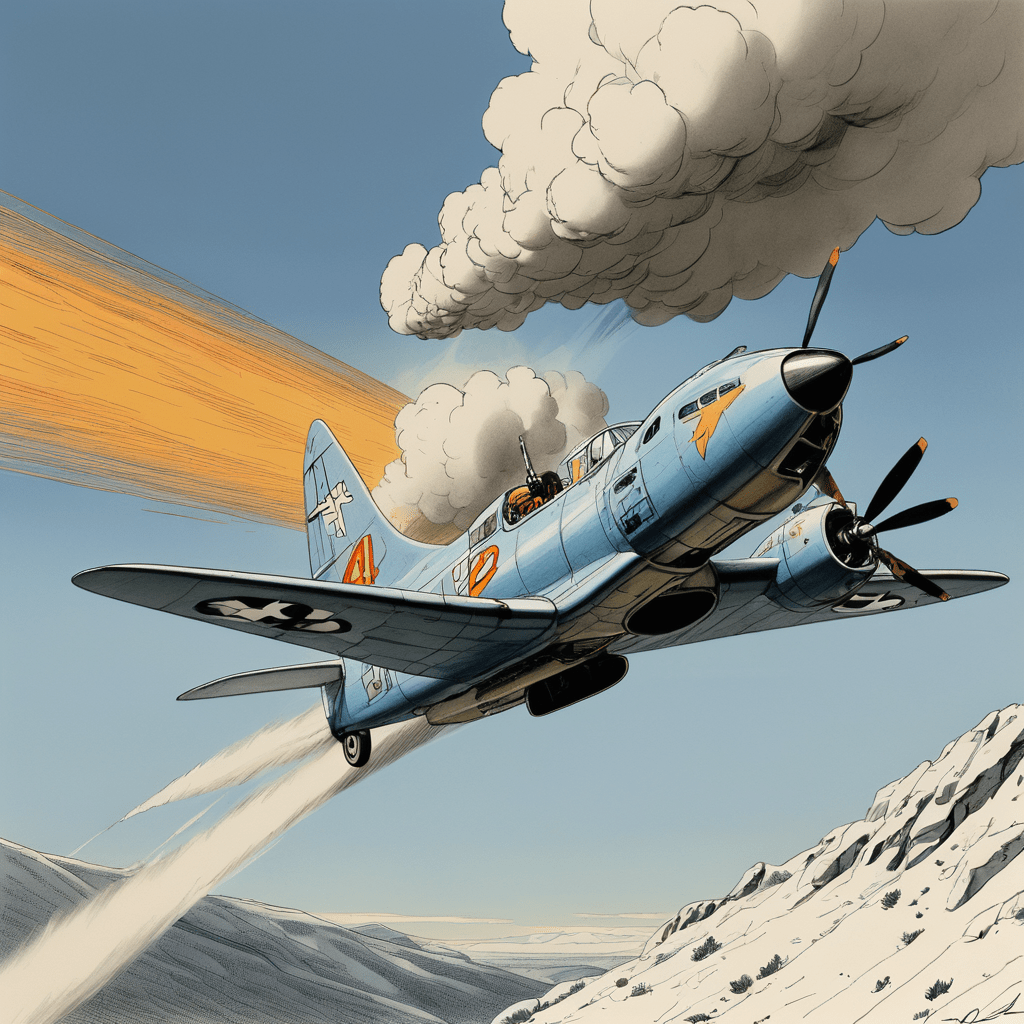
Swooping low over the snow covered mountains, Chuck Yeager accelerates his open cockpit, radial and inline engined powder-blue X-1 to beyond the speed of sound. Breaking the sound barrier has caused the very sky to rupture into a crazy yellow flare effect and Yeager, his rifle pointing directly upwards, has opened the bomb bay out of sheer delight. Soon, he will be forced to land wherein the absence of any kind of undercarriage except the tailwheel may become problematic.
1950: F-86 Say-bore

AI generously came up with two possibilities for the F-86 Sabre and they are both so good that I could not reasonably judge between them. On the left, the twin seat and famously complicated Sabre and to the right, the famously rotund and also complicated Sabre. Who would wish to be a MiG-15 pilot when faced with these beauties? Robot-Rembrandt has successfully rendered the F-86(s) as nice and shiny but seems confused as to all other specifics of the well-known aircraft. In the case of the chunky one, he seems to be keen on giving this famous (ahem) jet a huge orange propeller (and two blurred black propeller blades too). Aspects of these two are pretty sleek and space-age in a whizz 1950s style, but does this make up for an otherwise crazed visual jet salad? Maybe.
1957: Boeing 7-ohhhhhhh-7

In 1957, Boeing flew the prototype of the 707 for the first time, arguably the most influential jet airliner ever built. As you can see, the triple zigzag fuselage would set the standard for all subsequent commercial aircraft and the total absence of wings, whilst at the time radical, is now more or less a given for all conventional jetliners. Remarkably, despite the basic design being nearly 70 years old, it is still unclear what many of the protuberances around the nominal middle of the aircraft are actually for, but Boeing just keeps building them and bolting them on regardless. The wide separation of the two cockpits prevents any disagreements between the flight crews from descending into violence.
1967 F-Flawed Phantom

Wooooahhhh!! It’s the midst of Operation Rolling Thunder and the USAF is spending millions of tax dollars bombing trees. Mechanical Michaelangelo has managed to make this F-4 Phantom into some sort of crazed and magnificent turbo-bastard and it is undeniably very exciting. Drilling into the specifics a bit, once again there is a distinct flavour of Phantom, this melange is kind of recognisable, and for an aircraft once nicknamed ‘Double Ugly’, the sheer amount of vertical tails suggests that ‘Triple Ugly’ would now be a more accurate moniker. Not sure what it’s carrying underwing but some of whatever it might be is firing or exploding or whatever so that’s cool. The rear fuselage feels very much like an exercise in how many bulges can be aded to a bulgy thing before it becomes too bulgy but I think they’ve managed to keep it to peak bulge without going too far bulgewise (of course you may disagree: that is the very cornerstone of art appreciation). Curiously, our AI chum is so proud of this one that he/she/it has signed it in the bottom right corner revealing their name to be “L. Goviamuccio” apparently, which I for one was not expecting. Is AI Italian?
1989: North-flop B-2

Ending on a high: this is the B-2 ‘Spirit’ taking its first publicly acknowledged flight and AI has contrived to make it look, if anything, better than the real deal. Not sure how stealthy this design would be, those lumpy bits halfway along look suspiciously reflect-y and the fins may be a bit problematic but it’s been painted matt black and that’s good enough for me. No need to worry about compressor faces in the intakes compromising the radar signature because it hasn’t got any. Is it a glider? Whatever. I’m not entirely sure if it’s coming towards us or hurrying away, but I suppose that’s an advantage for a stealthy aircraft.
Well, that was all the American aviation history worth ruining that our AI friend could be bothered with today. Who knows, maybe some more will be forthcoming before the apocalypse? One can but dream (of Electric Sheep).
Hush-Kit does a lot for your entertainment, like a lot. If you agree and want to say thanks then hit the donation buttons on this page or support us on Patreon. This site is constantly in aq state of precarious survival, so consider supporting us. I don’t want to add a paywall as I’d like to keep the 1000+ articles free for everyone.
We’re also on Twitter X and Instagram and Facebook, and Substack.
Love & aeroplanes, Hush-Kit