

With its chiselled beak (somewhat like the fictional Firefox) and diamond shaped wing, the BAE Systems autonomous collaborative platform (ACP) concept revealed at WDS2024 is an extremely interesting design. We asked Jim Smith to consider it in more detail.
To understand a vehicle like this, my approach is to see what can be inferred from the information available about what might be the design requirements for the platform, and then see what inferences can be drawn about its intended use. All we have to go on in this instance are four images from WDS 2024.
The BAE Systems UCAV has a diamond shaped YF-23-like planform but with a relatively short forebody. The wing leading edge appears to be rounded, rather than sharp, and this, coupled with the geometry of the forebody and wing, suggests a modest design mach number around 1.4. The concept shown appears to have a chin-mounted engine intake, single-engine and butterfly tail surfaces, along with an extension of the trailing edge on the inboard half of the wing.


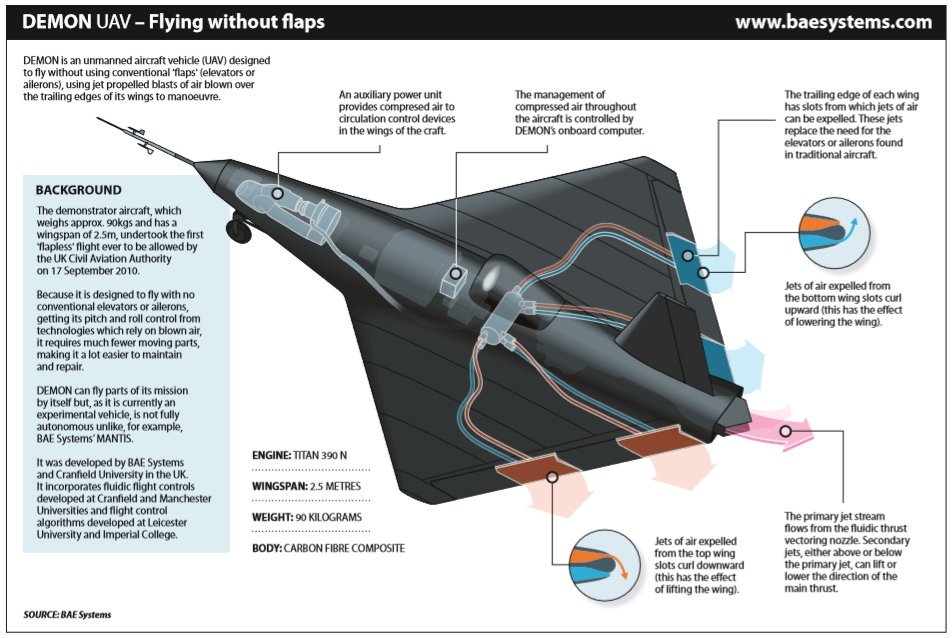
None of the surfaces of the aircraft feature any indication of moveable controls, and while this may be an example of artistic licence, it does raise the possibility that this uncrewed concept may draw on the BAE Magma demonstrator of 2019. Magma demonstrated the ability to use circulation control at the trailing edge of the wing, coupled with fluidic thrust vectoring of the exhaust, to successfully fly a UAV with no moving control surfaces. The tail fins on the UCAV appear quite small, and one wonders whether circulation control in yaw might be being used, because of the high lift coefficients that are achievable.

The fuselage shape features sloping sides, and seems relatively narrow, compared tp other aircraft with internal weapons bays, such as the F-22, F-35, and the SAAB UCAV discussed in the first part of this article. Propulsion for this UCAV is not explicitly revealed. There appears to be a single rear exhaust, and the fuselage shaping appears to suggest a chin intake. If this is the case, the volume available for weapons bays may be quite constrained suggesting a limited payload, although the absolute scale of the model displayed at WDS2024 is unknown.

Some aspects of the concept do represent an enigma. If low radar signature is so important that the design of the wing and control system is driven by signature targets, it is odd that a chin intake would be used, rather than a dorsal intake. Not only might this represent a problem in reaching signature targets, it also compromises the volume available for internal stores and/or systems carriage. That said, both the F-22 and F-35 feature large, angular intakes, suggesting technologies are available for reducing the signature due to the intake.
Possible Applications
So, the concept appears to be directed towards low radar and infra-red signature, with modest supersonic performance. The wing, while offering, perhaps, relatively low frontal, side, and rear aspect signature, is not a particularly efficient shape for either range or sustained manoeuvre. However, circulation control on the wing could offer high instantaneous turn rate, due to the high lift coefficients which are achievable.
The fuselage could, perhaps have more volume for fuel and payload were a dorsal intake to be used, but advanced circulation control and fluidic control systems may be incorporated.
What, then, might be the purpose of such a concept? One can only speculate. I wonder whether this is a further technology demonstrator, rather than a fully developed UCAV concept. The intent might be to show that the novel control system offers the possibility of combining high agility with low observables. This possibility is supported by the rounded wing leading edges, which would assist in developing a highly manoeuvrable system.
With a combination of high manoeuvrability, low signature and relatively small weapons bays, I wonder if this is a first attempt to demonstrate an uncrewed air combat capability, capable of manoeuvring beyond the human imposed constraint of about 9g, perhaps up to 12 or even 15g. It would achieve this by using rapidly varying wing lift enabled by circulation control, and its relatively low roll inertia to be able to change direction very rapidly,
So, perhaps, not just a loyal wingman, but an uncrewed warrior, challenging threat air defences, and particularly air defence aircraft with manoeuvrability, low signature, and perhaps long-range air-to-air missiles. If such a system could be made really combat capable, threat air defences would have little choice but to respond, forcing threat fighters to both expend weapons and manoeuvre aggressively, reducing their ability to respond to a follow up attack by crewed fighters.
Of course, cooperative use of active and passive sensors could also be useful, in increasing the capability of both fighter and strike aircraft to locate and prosecute targets. Â
Support The Hush-Kit Book of Warplanes: Volume 3 here

Overall, the BAe concept looks like a significant extension of the technology demonstrated by the Mamba UAV, in the direction of not merely a Loyal Wingman, but the possible development of an Uncrewed Warrior. That said, there are a huge number of big assumptions here, based on what might be no more than a Teaser for the WDS2024 audience.
BUY THE HUSH-KIT BOOK OF WARPLANES HERE.

PRE-ORDER VOL 2 here.
Vol 3 funding to be launched soon!

Support this site here.
Jim Smith had significant technical roles in the development of the UK’s leading military aviation programmes from ASRAAM and Nimrod, to the JSF and Eurofighter Typhoon. He was also Britain’s technical liaison to the British Embassy in Washington, covering several projects including the Advanced Tactical Fighter contest. His latest book is available here.

