

We counted the number of kills per Spitfire mark so you don’t have to. Here are the top 10.
10. Spitfire Mark VII – 24 victories
Victories per air-frame: 0.16
The pointy seven as high as heaven
Spitfire VII – ‘phenomenal with pointy wing tips and a phenomenal rate of climb.’

Gareth Nowell, Jack Cleland, A.D.Yeardley 2
The Mark VII was designed to counter what turned out to be the over-hyped threat of high-altitude Luftwaffe bombers (in the shape of the Junkers Ju 86P). This would help drive the crucial development of the two-stage supercharger, leading to a transformation of Spitfire performance starting in 1942. The first of the high altitude models had been the Mark VI, which saw some action and managed a handful of victories, which was basically a Mark V with a semi-pressurised cockpit (which rather worryingly came with a non-slidable canopy) and longer pointy wings. This was adapted into the much better Mark VII, which replaced the Mark VI and would equip three squadrons, flying operationally from Spring 1943 to late summer 1944.
While the VII superb plane that matched the Mark IX in almost every way, the problem for the IX was that the it was the same the other way around; the Mark IX matched the Mark VII in every way, higher altitude performance, and was introduced sooner with great effect. As a result, just 146 Mark VIIs were built. Though few, they would be used effectively in Channel sweeps and ramrod raids, racking up 24 victories. 602 Squadron’s Ian Blair flew a Mark VII in the Orkneys and loved it, succinctly summarising the aircraft as ‘phenomenal with pointy wing tips and a phenomenal rate of climb’.
9. Seafire IIC / III – 37 victories
0.03 victories per airframe (10th)
Richard Reynolds 3.83
‘Like a Duck to Weightlifting‘

It’s a bit of a cheat to aggregate the main two Seafire marks which saw action in World War 2, but otherwise only one mark would fit this review. The Seafire was an attempt to make the Spitfire something it wasn’t – a carrier-borne fighter. It had very significant problems – the small narrow undercarriage, fragile fuselage, forward view over the long Merlin engine, and a very limited range and loiter time. Yet its biggest problem was timing – it missed its great opportunity to impact the war by just a couple of months. Seafire squadrons weren’t ready for the one vital mission where its short-range interception qualities would have been perfect: the Operation Pedestal convoy to Malta, where Sea Hurricanes, Fulmars and Wildcats battled a concerted Luftwaffe and Regia Aeronautica assault. Thereafter, with the war turning decisively towards the allies, and despite performing intensive patrol duties and racking up an impressive record of landing accidents during the North African, Italian and French landings, it got very little opportunity to show off its real fighting virtues once in the air. In 1945 it would get an opportunity in the Pacific as the Royal Navy joined the US Navy in the final battles over Okinawa and Japan. They proved notably adept at intercepting kamikazes, and were probably would have been more able to combat powerful new Japanese shore-based models like the Shiden and Ki-100 than the hitherto superb Hellcat, but the Seafire ran out of war, with its highest daily total of seven victories on the very last day of the war, August 15 1945.
8. Spitfire Mark XVI – 40 victories
0.04 victories per air frame (9th)
The best sixteen ain’t a Viper

Stephen Butte (Can) 3
While its number matched its chronological order of its arrival in late 1944, the Mark XVI confusingly arrived in service a full year after the Mark VIII and Mark XIV, which were both superior in performance. This stemmed from the fact that the Mark XVI was basically a Mark IX but used US Packard-built Merlin 266 engines instead of the home-grown RR Merlins. A big plus clearly was to take advantage of the US production line of Merlins. But the opportunity to take advantage of mass production at the cost of cutting-edge excellence is just so-unSpitfire. Not that it was a bad fighter – it was on a par with the still-excellent Mark IX and quite a few XVIs sported the bubble canopy, giving a step up in visibility, and clipped wings, being used in a fighter-bomber role. It started equipping squadrons in late December 1944, as attrition from the European campaign started to bite, but for most squadrons it arrived too late for the war. With much of its focus on ground attack missions, including attacks on V2 launch sites, the Mark XVI was not one of the highest scoring models, with just forty victories altogether, including three in a single mission by Canadian Stephen Butte.
Many Mark XVIs were built with the all-round view bubble canopy and cutback rear fuselage, more associated with Griffon-engined Spits. By the way, you can already pre-order The Hush-Kit Book of Warplanes Vol 3 here, it looks to be amazing.
7. Spitfire Mark XII – 53 victories
The lucky 7
0.53 victories per airframe
Raymond Harries (Wal) 10.5; Grey Stenborg (NZl) 4.33
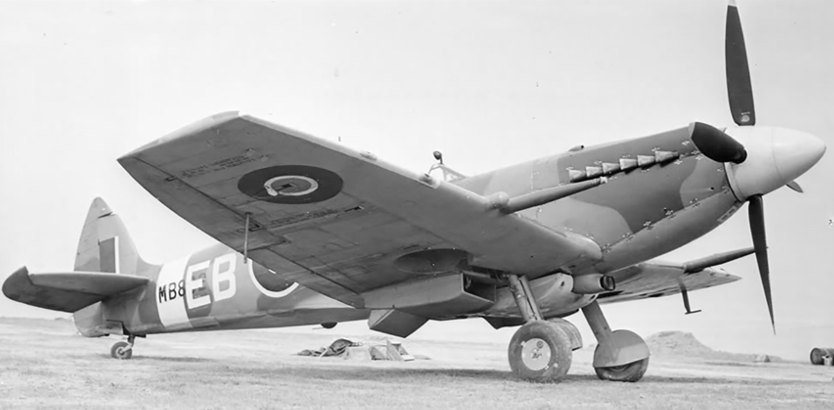
The Mark XII was the first Griffon-engined Spitfire to reach production – a hastily lashed together hybrid, borrowing Spitfire V and later Spitfire VIII airframes, with the Griffon requiring a disproportionately stretched nose and propellor spinner, topped off with sawn-off wings. It proved an excellent low-level fighter using a single-stage supercharger, yet just 100 were built as effort quickly switched when the twin-stage version, the Mark XIV, arrived soon after. As a result, the XII equipped just two squadrons at its peak – 41 and 91, between April 1943 to September 1944. It proved an ideal candidate to tackle nuisance Focke-Wulf Jabo raiders. As the 91 Squadron diary related, ‘We got the Huns tonight, five of them, all in the drink…’
The Mark XII also flew fighter escort for early B-17 raids and ‘rhubarb’ missions, with B-26 Marauders – with notable success. Indeed, 91 Squadron with its XIIs would be the top-scoring squadron of September 1943 with 18 victories, led by their inspirational leader, Welshman Raymond Harries. Despite this, the Mark XII would have a short career, being phased out of the front line in September 1944 as both its squadrons re-equipped with Mark XIVs.

Raymond Harries – top Welsh ace of WW2, and also top scorer in Griffon-engined Spitfires,
all scored in the Mark XII (10.5 of his 16.5 victories).
6. Spitfire Mark XIV – 154 victories
A 14 with more one more kill than the F-14 Tomcat

0.17 victories per air frame
Aces: Harold Walmesley (Rho) 9.25, Ian Ponsford (Eng) 7
The Mark XIV was the classic Griffon-engined mark, and makes a compelling bid to be the best fighter of the war, with an astonishing climb rate of nearly 5,000 feet per minute and speed just shy of 450 mph. With its bubble canopy, stretched, cut-back fuselage and enlarged tail fin, the Spit XIV was very different beast to the puppy-like Mark I. It was the first Griffon Spit with the new two-stage supercharger, and the first Spitfire to break 2,000 horsepower. And like the Spitfire IX, the Mark XIV was actually intended as a stopgap until the more thoroughly revised Mark XVIII arrived. The not quite perfect, yet sensational, Mark XIV thus arrived with squadrons in time to make a real impact on the air war.
The first Mark XIV squadrons arrived with 610 Squadron in early 1944, and while opportunities for conventional air combat over Britain were minimal, these high performance fighters were ideal to counter a sinister new threat, the V1 pilotless bomb. Spit Mark XIVs would shoot down 249 V1s – with 185 claimed by 91 squadron alone (exceeded only by two Tempest squadrons). The first deployment on the continent would be in late 1944, and the Mark XIV’s first victories came late – on 23rd January 1945, when Pilot Officers Benham and Hegerty despatched three Fw190 Doras. After this, the Mark XIV started to take an increasingly important role in enforcing air superiority. The five weeks from the start of April 1945 to the war’s end saw the Mark XIV achieve total dominance wherever it flew. They amassed 90 victories and produced some of the war’s last aces, such as 130 Squadron’s Harold Walmsley and Ian Ponsford, who considered the Mark XIV as ‘the best operational fighter of them all as it could out-climb virtually anything’. 91 Squadron reported 33 victories in this period without a scratch to a single plane in aerial combat. Not withstanding the presence of jets, the war ended with the Spitfire as dominant as at any time in the previous six years of war.
5. Spitfire Mark VIII – 202 victories
0.14 kills per air frame
Top aces: Albert Houle 7, Neville Duke 6, Robert Day 5.5
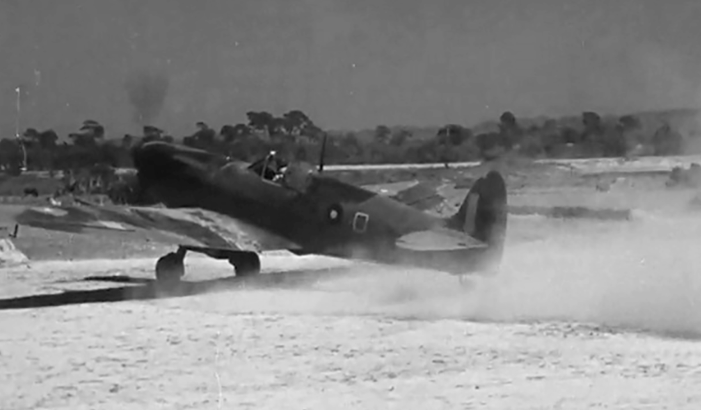
The gorgeous Mark VIII was what the Mark IX would have been without the need to rush it into service. It was in essence the ultimate Merlin Spitfire. It took a number of design refinements from the two excellent high altitude Spitfire Marks VI and VII, such as the pointed tail fin, retractable tail wheel (but not the pressurised cockpit). It was also fully tropicalised, and its combat career would be restricted to warmer climes – the Mediterranean and India/Burma campaigns.
Though exquisite in performance and in looks, the Mark VIII didn’t accumulate a lot of victories – the Mark V and Mark IX had already done a great job of decimating the Luftwaffe before the Mark VIIIs arrival in Italy in late 1943. However, they did provide excellent service, and an interesting aspect of the VIII’s arrival was it came to the RAF (and SAAF) and USAAF at the same time, and served alongside comparable numbers of Mark IXs (and also Mark Vs), so a friendly comparison can be made in terms of its performance (see table). This suggests the VIII had a distinct edge in air combat over the Mark IX, recording a stellar air-to-air kill ratio just shy of 10.
Table showing Spitfire victories and losses over Anzio and Cassino, January to March 1944. Note heavy losses to AA and mechanical failure as Spitfires were increasingly employed in ground attack operations – particularly the old Mark Vs.
| RAF | USAAF | ||||||
| Kills | Losses (air) | Losses (AA/mech) | Kills | Losses (air) | Losses (AA/mech) | Air-to-air kill ratio | |
| Mk V | 2 | 1 | 19 | 37 | 7 | 12 | 4.88 |
| Mk VIII | 51 | 7 | 15 | 28 | 1 | 2 | 9.88 |
| Mk IX | 42 | 11 | 19 | 33 | 4 | 5 | 5.00 |
In Burma, the Mark VIIIs timely deployment in January 1944 was transformative. At the Admin Box, General Slim had trained his forces to stand fast after being surrounded, the key being that the cut-off forces were to be supplied by air – this despite Japanese air superiority. In just three days, just two squadrons of Mark VIIIs mauled the Japanese fighter and bomber formations, registering over fifty claims of destroyed or damaged. Not a single Dakota flying into the Box was lost, with the result that it held firm, and the first major victory against the Japanese Army was achieved. Victory after victory followed for Slim and the 14th Army, and Mark VIIIs would be unchallenged by an increasingly scarce Japanese Army Air Force thereafter.
.

4. Spitfire Mark II – 334 victories
0.36 per airframe
Top aces: Douglas Bader 10.5; Harbourne Stephen 7.5

Fated to be one of the most overlooked marks, the Mark II arrived towards the end of the Battle of Britain, with Sailor Malan’s 74 Squadron the first to receive it on 24th September. Such was the pace of fighter development, it was being replaced by the Mark V in the spring of 1941.
There was plenty to fix on the Mark I so the Mk II included some sensible developments. It featured an uprated Merlin XII engine with 140 more horse-power, while experimentation with cannon armament continued. Spitfire IIs would also all be fitted with ‘Miss Shilling’s orifice,’ in early 1941, which prevented the engine cutting out when inverted or rolling. Yet perhaps the main significance of the Mark II is that it was the first to be churned out by the controversial state-financed Castle Bromwich plant, once Lord Beaverbrook had fired Lord Nuffield for its chaotic failure to deliver earlier Spitfires, a failure which might even have cost the war.
In combat, it provided a modest step forward on the Mark I, and it would see some action in the late stages of the Battle of Britain, but it would mainly be a victim of poor tactical deployment: Douglas and Leigh Mallory’s ‘lean towards France’, when this short-range interceptor was despatched on an interminable and wasteful cross-Channel Circus and Rhubarb operations. In July 1941, the month of peak folly when 116 Spits were lost, nearly half (54) were Mark IIs. This was also the period of ops when RAF overclaiming reached 6 to 1, so it seems very likely the Mark II had both the highest overall overclaim rate of any Spitfire mark, and even worse (and uniquely), suffered more air-to-air losses than actual victories. Unlike the Mark V, it didn’t get a second chance overseas.
3. Spitfire Mark I – 1353 victories
Victories per airframe: 0.86 (1st)
Top aces: Eric Lock 21; Colin Gray 16.2; Brian Carbury 15.75
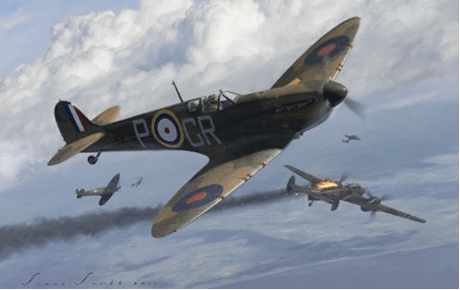
Obviously the Spitfire Mark I played the starring role in the most significant air battle of all time. Not only that, but as a warm-up, the Spitfire was thrown into the equally desperate struggle of Dunkirk to make its proper debut in battle. The only argument is the degree to which the Spit I deserves the plaudits, given the work by its more numerous partner, the less photogenic Hurricane. What isn’t in doubt is that no fighter marked its arrival with a bigger victory.
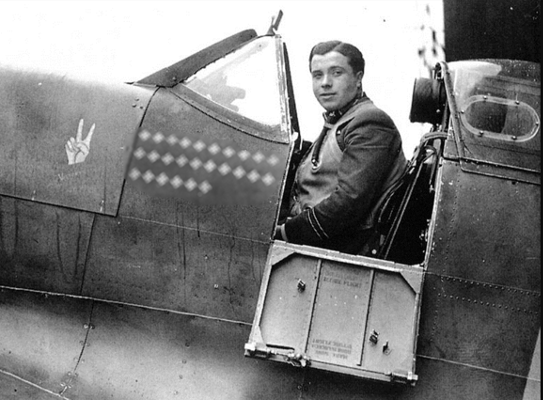
Spitfire Is scored 19 victories in the Phoney War, beginning with the destruction of a Heinkel He111 over the Firth of Forth on October 16th 1939. Unlike the Hurricane, they were kept out of the disasters in Norway and France, but the Dunkirk emergency saw 16 Spitfire squadrons rotated in and out of the air battle, a tough baptism with so much at stake. It was a challenging debut – poor RAF tactics like the close vic formation contributed to unnecessary losses, as did an attempt to introduce big wing tactics. On the plus side, pilots who would become indelibly associated with the Spitfire, namely Al Deere, Bob Stanford Tuck and Sailor Malan, emerged as aces, and they inflicted serious losses were inflicted on the Luftwaffe, with 161 victories (not counting a significant overclaim).
Dunkirk was followed swiftly by the Battle of Britain, the most intensive few months of fighter combat in RAF history. Opinion is split on just how much credit the Spitfire deserves in the battle, but the fact that the Spitfire was at least a match for the Me109 was an absolute keystone to battle tactics and to victory. As the table below bears out, Spitfires shot mainly fighters down, while Hurricanes, a (marginally) better gun platform, recorded a higher proportion of bombers. Spitfire squadrons also tended to be higher scoring. They both played a huge part in a magnificent victory.
| Total est. victories | Victories/ squadron | Me109 | Me110 | Stukas | Bombers | |
| Spitfire | 1156 | 60.8 | 56% | 12% | 3% | 24% |
| Hurricane | 1480 | 46.25 | 36% | 20% | 10% | 33% |
Yet despite this monumental contribution to one of the most consequential air battles of all time, the Mark I would disappear in the blinking of the eye. The Merlin II /III engines were competitive for 1940, despite one or two quirks (like the that the carburettor flooding the engine in an inverted dive), but the Mark II was already being phased in by the Autumn. This was perhaps fortunate for the Mark I’s impeccable combat record, as it was almost entirely replaced by Mark IIs by March 1941, and just four Mk 1s would be lost in Leigh Mallory’s ill-conceived Circus and Rhubarb operations.
Top-scoring Mark I pilot and leading ace of the Battle of Britain, Shropshire’s Eric ‘Sawn off’ Lock, who scored 21 victories in the Mark I.
- Spitfire Mark IX – 1520 victories
Victories per air frame: 0.25 (5th)
Top aces: Johnny Johnson (Eng) 29.08; Donald Laubman (Can), Wilfred Crawford-Compton (NZl) 15
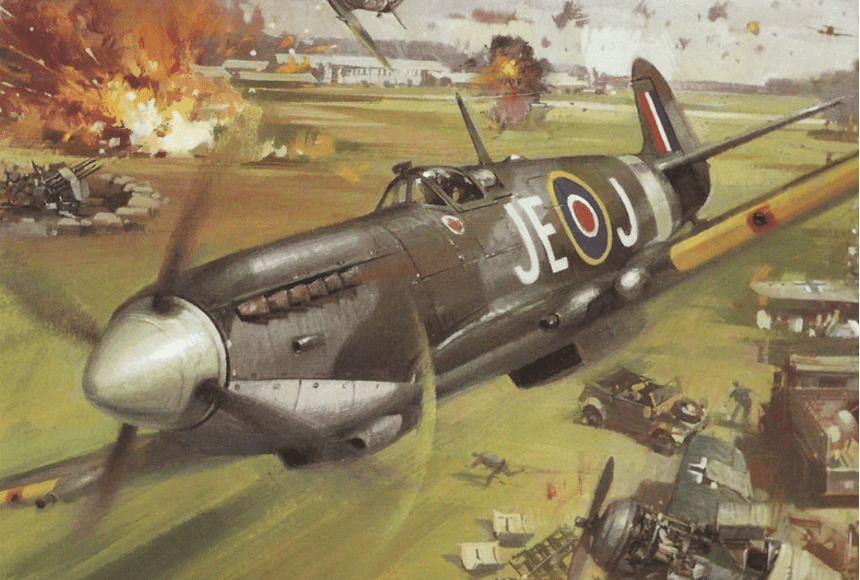
The arrival of the Mark IX in June 1942 was the moment that put the world back on its axis and restored the Spitfire to its rightful place as the best fighter in the world, coinciding directly with the tide of the war turning irrevocably. Jeffrey Quill described the Spitfire IX as a ‘quantum leap’, and the mark would serve in the majority of RAF squadrons for the remaining three years of war with distinction.
In design terms, it wasn’t actually a quantum leap. It was the Mark V air frame modified to accommodate the new, larger and more powerful Merlin 61, equipped with Stanley Hooker’s two-stage supercharger. It provided the boost that meant the Spitfire IX matched the Focke-Wulf Fw 190 in key measures like speed and climb rate, provided better manoeuvrability and best of all, provided stunning high-altitude performance. The IX marked the end of the Focke-Wulf supremacy, with its first operations being to pick up the wretched Circus and Rhubarb fighter sweeps, with some IXs involved in the Dieppe fiasco. They also provided escort for US 8th Air Force formations for their first year of operations, and although their range seriously limited their use here, they proved excellent at minimising US bomber losses. They gave way to the much longer range P-47s and P-51s at end of 1943.
The Mark IX also joined the final stages of the Tunisian campaign, dealing handily with considerable Luftwaffe reinforcements. The arrival of the Spit IX, would help ensure another arrival, the Focke-Wulf Fw190, would have quite limited impact in the theatre, and in Sicilly and Italy, they attained dominance over Luftwaffe fighters in a way not seen before in the war. However, the Spitfire IX’s greatest achievements were over Normandy and Western Europe following D-Day, where they helped ensure air superiority despite ever more Luftwaffe fighters being thrown into the fray. The Spitfire IX was involved in some huge air battles, with the Canadian Fighter Wing racking up some impressive scores under the leadership of the top Spitfire ace of all time, Johnny Johnson. Spit IXs amassed 393 victories over Normandy in the weeks following D-Day. Spit IXs also scored heavily in the fighting over Belgium and the Netherlands, and a Mark IX from the Canadian 401 Squadron would be the first to shoot down the new Me262 jet on 5th October 1944. On December 29th, Norwegian and Canadian Spit squadrons massacred the elite III / JG54 ‘Green heart’ gruppe, destroying 17 of the new Focke-Wulf Fw 190 Doras and killing the commander and 122-victory ace, Robert Weiss.
Like the Mark V, the IX was also heavily used by customers – it started to replace the V with the US 31st and 52nd Fighter Groups in Tunisia, Sicilly and Italy, while the Soviets also took 1200 Mark IXs, and although they were employed in a prestigious city defence role, they scarcely saw any action. Mark IXs were also at the heart of the bizarre three-way Spitfire battle during the Palestinian crisis of 1948. In the end, this superlative model amassed over 1,500 victories, remaining fully competitive and playing a great role in securing battlefield air supremacy right up to the final day of the war in Europe.
The greatest of Spitfire aces, Johnny Johnson, leader of the Canadian fighter wing of Mark IXs over a Luftwaffe airbase. Johnson shot down 21 Fw190s – more than any other allied pilot.
- Spitfire Mark V – 2560 victories (1st)
0.39 victories per airframe (3rd)
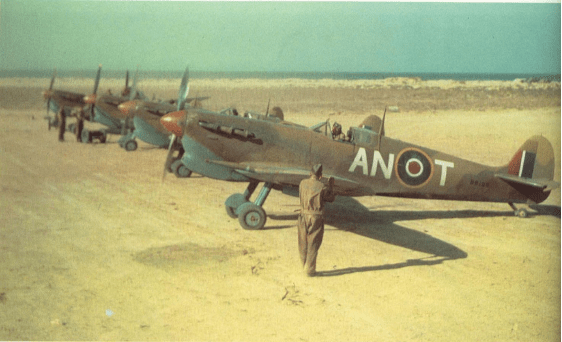
Top aces: George Buerling (Can) 29.33; Jamie Rankin (Eng) 18.75; Adrian Goldsmith (Aus) 16.25
The Mark V is never anyone’s favourite Spitfire. It was clearly outclassed by the Focke-Wulf Fw190, whose arrival caused a major panic in RAF circles, and even led to a loss of faith in the Spit itself. It formed the majority of Spits during Douglas and Leigh Mallory’s ineffective and wasteful Circus and Rhubarb operations of 1941, so became inextricably associated with that failure. The numbers simply embarrassed it. The period of June to December 1941 saw big claims – but 713 claims translated into just 103 Me109s lost to enemy action with 413 Spits lost in the same period. And this was before the Mark V was comprehensively outclassed by the arrival of the Focke-Wulf Fw190, with the humiliation of the Channel Dash and the massive losses in the air battle over Dieppe.
Mark Vs were also the first to model Vokes and Aboukir filters, clipped wings and other such abominations which undoubtedly thwarted the original Spit’s sleek beauty. As the first Spitfire to be exported, it was despised by the Soviets, who briefly used and abused 200 Spitfire Vs during the Kuban campaign, and ultimately rejected it for the Airacobra. Even in Australia, it disappointed in the raids over Darwin where it failed to dish out the expected trouncing of Japanese raiders (although it still saw them off with minimal damage to the towns and bases in northern Australia).
And yet, in early 1942, the Spitfire V would re-invent itself by going international. It turned out this apparently mediocre fighter was exactly the plane to drop into a strategically hopeless situation facing Luftwaffe and Regia Aeronautica dominance. The Air Ministry finally prised a handful of squadrons of Spitfires from Douglas and Leigh Mallory and sent them to the besieged island of Malta, followed by further aircraft to the Libyan/ Egyptian front, where things were taking a truly dark turn in early 1942. The effect was really quite dramatic – particularly in Malta.
After the heroic mission to fly Spitfires off the decks of carriers to Malta, just five squadrons of Mark Vs turned a desperate situation around. The Canadian George Buerling led a pack of aces, running up 27 victories in just four months of fighting. Spitfire claims in Malta eventually reached over 680 victories. In North Africa, just three squadrons of Spitfires would provide top cover, holding the legendary JG27 desert wing at bay while Coningham’s Desert Air Force fighter bombers wrought havoc below among the Afrika Korps. In both cases, the Spitfire V, under the superb fighter generalship of Park, Coningham and others, played a hugely significant tactical role in consequential strategic victories. Further success followed in Algeria – once again, Spitfires were flown into a hot spot miles beyond allied territory, the very recently Vichy French Bone and Maison Blanche airfields, to face a furious Luftwaffe response. In one of the last periods where RAF fighters faced huge odds, the Spit Vs performed superbly, scoring 144 victories in just a month’s fighting – victories which matched closely recorded Luftwaffe losses. Even the arrival of its successor, the Mark IX, gave the Mark V a new lease of life – suddenly even Focke-Wulf pilots had to be more careful when dealing with Spits in case they attacked the new super-charged version. Over Sicilly, Spitfire Vs and IXs together achieved a kill ratio of 5:1, achieving an aerial dominance for the allies which was never lost; on one occasion, a Luftwaffe transport formation and its Me109 escort was mauled with Spitfires claiming 26 victories for no losses – 24 were credited to Mark Vs.
The upshot of all this was that the Spitfire V, despite its technical inferiority, mustered a heroic list of RAF battle honours, achieving crucial aerial victories which turned the tide of the war – and when all is added up, scored more victories than any other Spitfire mark. In looking at the final score sheet, we need to acknowledge that Spit Vs were the most heavily involved mark in the misguided ‘Non-stop offensive’ of 1941 where there was a startling level of overclaiming – at one stage passing six confirmed claims per Luftwaffe loss. This fell to about 2 to 1 in the Malta and North African air battles – and was below 1.5 to 1 in Tunisia and Sicilly. So even factoring an overall overclaim of a little over 2, there is little doubt that the Mark V was the top-scoring Spitfire.
Top Spitfire Mark V pilot was the maverick Canadian George Buerling, who outscored several great Luftwaffe aces, such as Joachim Muncheberg, Gerhard Michalski and Siegfried Freytag to be the top-scoring ace on either side during the Battle of Malta, scoring 27.33 victories (of his 31.33 total).
Notes
As always with aerial combat statistics, it comes with major caveats. Firstly, the numbers given are estimated confirmed claims, gleaned painstakingly from a number of authoritative but occasionally conflicting sources, but with no single complete data set. Where there are gaps I’ve made best estimates, so error might have crept in, and I’m happy to recalibrate if there is new or conflicting information. Secondly, the numbers are for victories confirmed by the RAF or allied authorities, which famously can vary considerably from actual losses suffered by Axis forces.
We’ve had issues with YouTubers plagiarising our articles , if you see this happening please let us know.
-Numbers compiled by Eddie Rippeth
You can make The Hush-Kit Book of Warplanes Vol 2 happen here
- FUNDING IS VERY LOW FOR THIS SITE
- Thank you for reading Hush-Kit. Our site is absolutely free. If you’ve enjoyed an article you can donate here. Hush-Kit depends on your donations to keep going, and funding is currently very low. If you love this madness then do support us, we may need to pause service if we can’t increase funding levels.
- If you like books, and you do, The Hush-Kit Book of Warplanes is now on general release and is bloody lovely. A big glossy feast of irreverent humour, delectable facts, thrilling combat pilot interviews, VERY obscure aircraft types, and MUCH more. You can order it here.
.

