

The F-35 is a Ferrari, the F-22 a Bugatti Chiron – the United States Air Force needs a Nissan 300ZX. Both the F-35 and F-22 have higher levels of technology than USAF requires for the vast majority of its everyday tasks. They are very difficult and costly to maintain, operate and upgrade. What is needed according to the USAF’s Chief of Staff Gen. Charles Brown Jr is an affordable, lightweight fighter to replace the F-16. It must be faster to develop and upgrade than the F-35 and need not feature such exquisite technologies. The only way to escape the exceptionally slow and expensive development process is to obey the following:
- A very fast project definition process. A sensible low-risk hard- and software solution is chosen and frozen within a year. Regular software updates are planned. A 1-year PD phase seems almost impossible if there were to be competition between L-M and Boeing. Single-sourcing without a contest would be necessary. The acquisition approach is likely to be a Government-directed prime contractor and engine supplier (P&W, on the grounds that the F-119 will be put back into production through this programme). Then a Skunk Works-like programme against a well defined, but small, set of mandatory requirements, with freedom given to the main contractor to choose sub-contractors. The Government will specify the weapons fit, digital interfaces for datalinks and weapons, all other sub-contractors to be selected by prime. The contract will be incentivised for rapid delivery, with stage payments for demonstration of successful integration of specific sensors and weapons systems. This approach should meet USAF objectives for timeliness, while ensuring a reasonable sharing of risk between Government and Industry. (If the PD phase is competed, you would need Boeing, L-M and N-G, and perhaps add at least a year to your schedule. But you might get a better price. One possibility is borrowing from old UK procurement policy: No Acceptable Price, No Contract, and deal with L-M, or have a 2-year competitive PD phase, with a model-based down-select to award a Prime Contractor.)
2. Move fast enough to minimise pork-barrelling. Bypass politicising the project through the removal of competitive element – all primary components sources decided at a very early stage unilaterally (and the same with secondary sources in the case of serious issues with primary contractors). As an alternative solution, 3D printing away from conventional factories could partly solve the pork barrelling issue.
3. A ‘Luddite Czar’ is appointed to block the addition of any new technologies, roles or excess weight increases during development. Personality required: exceptionally strong-willed, non-careerist disagreeable individual with high technical knowledge.
The Hush-Kit Book of Warplanes will feature the finest cuts from Hush-Kit along with exclusive new articles, explosive photography and gorgeous bespoke illustrations. Pre-order The Hush-Kit Book of Warplanes here.

Requirements creep is the enemy.
4. The smallest lowest tech production line possible is used. Plans are made for rapid expansion if large export orders are received.
5. Existing technologies used for engines, sensors and materials. Existing components are further simplified where possible.
6. A lower density design with surplus volume, surplus electrical generation. Minimum onboard computer intelligence and maximum data-linking. Remote mentoring as phase 2 enhancement once the technology is mature.
7. A simple fuselage shape with surplus volume that could potentially accommodate a game-changing advance in propulsion technology
8. Less emphasis on low radar signature than F-35 and F-22.
9. 3D printing used to maximum effect. Additive manufacturing. The application of 3D aerodynamic modelling to blended shapes.
10. Accelerated multiple prototype/test aircraft project concentrates on reliability and upgradability. Large test fleet is kept throughout aircraft’s left to robustly test updates.
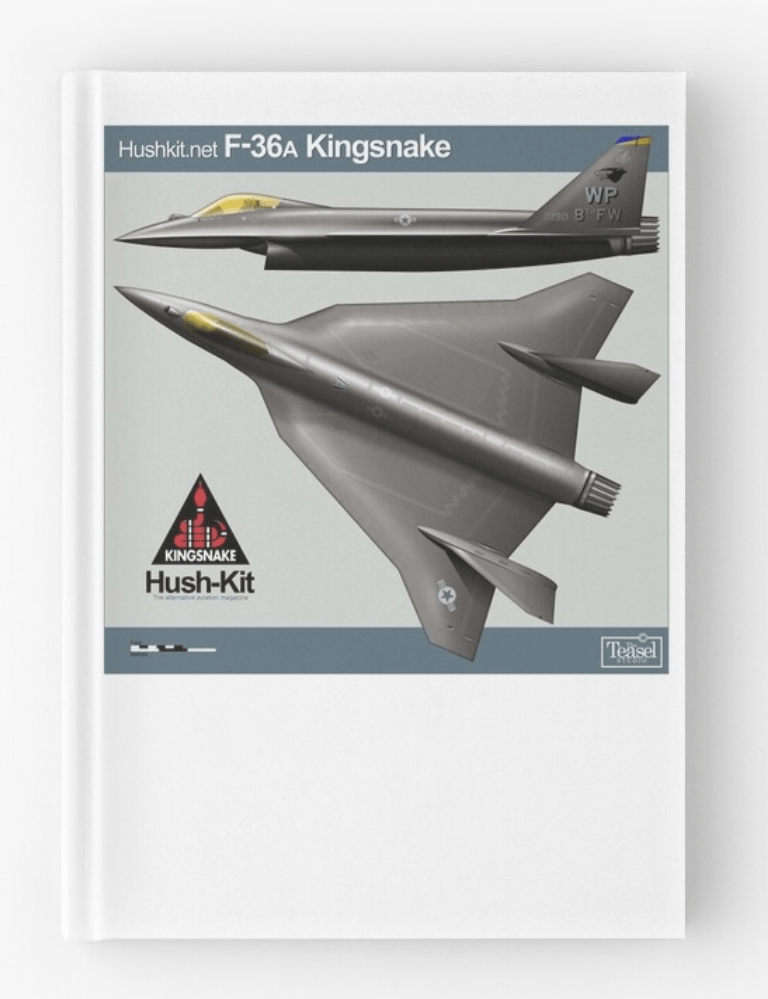
We wondered what might a notional ‘F-36’* look like? I enlisted the help of Stephen Mcparlin who spent 22 years at RAE/DRA/DERA/QinetiQ at Farnborough, using low speed, transonic and supersonic wind tunnels, while evolving and validating aerodynamic design methodologies for mostly military aircraft and James Smith, who had significant technical roles in the development of the UK’s leading military aviation programmes from ASRAAM and Nimrod, to the JSF and Eurofighter Typhoon, and the illustrator Andy Godfrey from the Teasel Studio to provide a visual representation.
*Jumping back to into the vacant F-20s designations seems retrograde and would involve solving the riddle of the YF-24
Save the Hush-Kit blog. If you’ve enjoyed an article you can donate here. Your donations keep this going. KEEP US PAYWALL FREE. We hate paywalls and would rather avoid them but there’s a lot of work that goes into this site. The Hush-Kit Book of Warplanes will feature the finest cuts from Hush-Kit along with exclusive new articles, explosive photography and gorgeous bespoke illustrations. Pre-order The Hush-Kit Book of Warplanes here.
Thank you. Our shop is here and our Twitter account here @Hush_Kit. Sign up for our newsletter here.
This is a new aircraft. What is the primary requirement? What we have come up with is a long range, supersonic, manoeuvrable BVR and WVR fighter. Of course, later in its life it will become an overweight bomb trucks, festooned with stuff, just like the F-16, but let’s not draw it in middle age just yet.
The design
The wing is based on that of the F-16XL. The cranked arrow has an inboard section of increased sweepback, creating a controlled high-lift vortex without the need for a foreplane. The wing is efficient at high speeds aiding in creating a faster fighter than the F-35. The F-35’s slowness is a disadvantage for the beyond-visual range mission. The wing also allows ample room for fuel (we can expect a higher full fraction for the whole aircraft than the F-22) and external hardpoints (one notable issue that requires long range is the likely ability of supercruising Chinese J-20s to outrange F-22s). The wing loading is lower than the F-35 for most given configurations. Rather than emphasising an extremely high speed that is rarely met (as the case with F-14 and F-15 etc) the F-36 is very comfortable achieving speeds in the mach 1.8-2 range, rather like the European Typhoon. The F-36 is designed for unreheated supersonic performance at M = 1.4 , using reheat for acceleration up to M = 2.0 .
On agility, the big wing will give great instantaneous turn rate, and energy manoeuvrability should be well up there with low wave drag and good T/W. As primary design is for BVR ,sustained turn performance is less important. Internal weapons are carried in intake trunking weapons bays, curving into the lower wing fillets. Likely weapons would include new generation long range air-to-air missiles.

Engines considered included the F-15EX’s F110-GE-129 which would offer commonality but lack sufficient thrust or the F135 of the F-35 which is suffering technical issues. The chosen powerplant is a simplified version of F119 of the F-22. Returning the engine to production would also benefit the F-22 Raptor force. It is estimated returning the engine to production would take 3.5 years meaning early test aircraft would need to borrow from the Raptor. The F110-GE-129 is a lower risk option. Unlike the F-22 , the F-36 does not have thrust vector control. The F119 production re-start would be expensive however and an uprated F110 and or improved F135 should not be ruled out.
Sensors
The primary sensor is the AN/APG-83 AESA and an IRST based on the LEGION POD.
Cockpit
The F-35’s cockpit concept was probably a little ahead of the state-of-the-art in some aspects. It has been criticised by pilots for its absent HUD and the lack of feel and unreliability of inputted commands relating to the touchscreen-centric approach. The F-36 cockpit will address both issues and will feature a widescreen HUD in conjunction with a Joint Helmet-Mounted Cueing System (JHMCS), a cheaper option than the F-35 helmet system.
Gun
With modern infra-red missiles almost guaranteeing a kill before fighters reach the merge a gun may seem an archaic inclusion and certainly Stephen McParlin was sceptical of whether one was needed. There are several reasons that the F-36 has a gun. The first is political: gunless fighters have a bad reputation, the second is practical: any F-16 replacement is likely to end up performing the Close Air Support mission. The weapon is the M61 Vulcan mounted in the starboard wingroot. It is not ideal to use supersonic optimised fighters for CAS and ideally the F-36 would be complemented by new or existing subsonic aircraft better suited to the mission.
We showed our speculative design to Bill Sweetman who commented “I think Harry Hillaker would have approved”.

The Hush-Kit Book of Warplanes will feature the finest cuts from Hush-Kit along with exclusive new articles, explosive photography and gorgeous bespoke illustrations. Pre-order The Hush-Kit Book of Warplanes here.

The Hush-Kit Book of Warplanes will feature the finest cuts from Hush-Kit along with exclusive new articles, explosive photography and gorgeous bespoke illustrations. Pre-order The Hush-Kit Book of Warplanes here.

