

The US V-22 Osprey is a class of aircraft unto itself as it is the only manned tilt-rotor in service. Former Head of Future Projects at Westland Helicopters Ron Smith argues there’s a reason for that: it offers little and costs a king’s ransom.
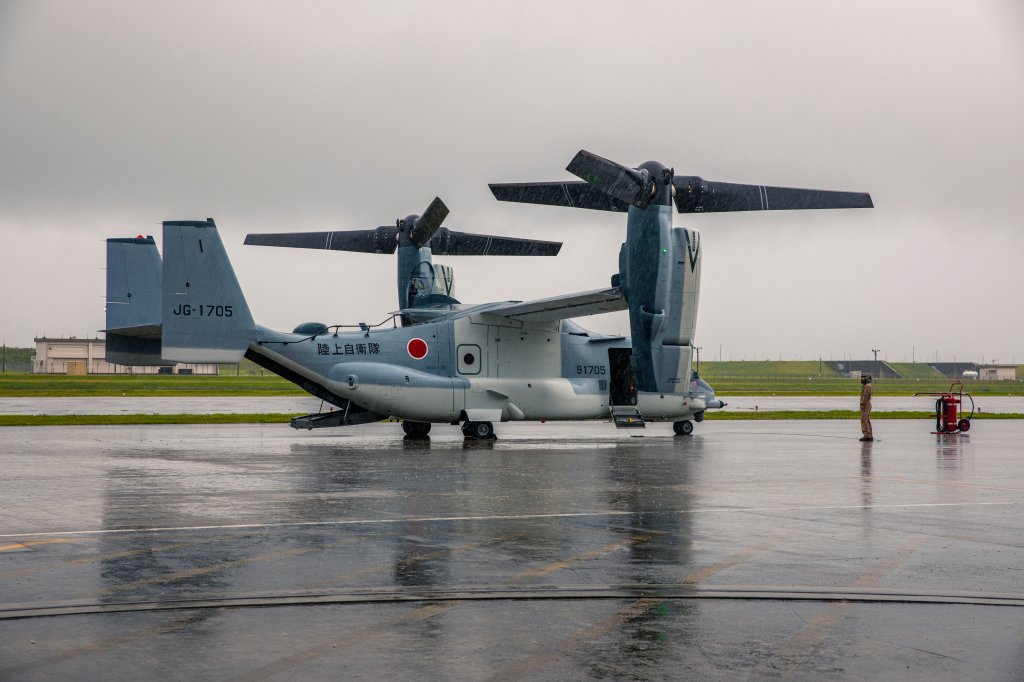
The V-22 Osprey is a tilt rotor design that is used by the US Marine Corps and Air Force and 39 CMV-22 aircraft are being procured by the US Navy. The Japanese Self Defense Forces are acquiring five aircraft, Indonesia has ordered the type and Israel is very interested.
The V-22 has two large engines (6,150 hp), one mounted on each wing-tip, driving a 38 ft diameter three bladed propeller. The angle of the engine nacelles can be varied from in line with the wing up to ninety degrees to the wing to enable the aircraft to take-off and land vertically. In fact, the nacelles can tilt beyond the vertical by some 7.5 degrees to allow rearward flight or hovering in a tail wind.
So we have an aircraft that can operate like a conventional twin-engine turboprop aircraft in cruising flight and can hover like a helicopter and take-off and land vertically. That sounds like a great idea, doesn’t it?
Hover analysis
There are a couple of design issues, however. When hovering, the rotor diameters are smaller than one would expect for a helicopter in the same weight class. The V-22 has a maximum vertical take-off weight of 47,500 lb and can carry 24 seated troops.
The rotor diameter is restricted by the need for its tips to be clear of the fuselage when flying as a conventional aircraft in forward flight. This results in a higher disc loading (weight over rotor area) of around 21 lb/sq ft than would be expected for a helicopter in this weight class. This equates to reduced hover efficiency and a greater downwash (wake) velocity beneath the rotor.
The efficiency of the rotors in the hover is also suffers from the fact that the blade twist has to be a compromise between that required for an efficient hover and that required for efficient cruise flight. A second penalty arises because the wing blocks part of the airflow down from the rotor, creating a downward force that opposes the rotor lift.
My comparison helicopter is the relatively old Sikorsky CH-53D. This aircraft weighs 33,500 lb, has a rotor diameter of 72 ft 2.8 in and can carry 38 – 55 troops. The disc loading of the CH53D is around 9 lb/sq ft, under half that of the V-22. Now, the power required to hover depends on disc loading so that the V-22 will inevitably require significantly more power to hover at a given weight.
The installed power of the V-22 is (maximum) 2 X 6,150 hp or 12,300 hp total, the total maximum continuous power is 11,780 hp. By comparison, the installed power of the CH-53 is 2 x 3,925 hp, a total of 7,850 hp. The upshot is that the V-22 is 40% heavier than a CH-53, has 57% more installed power but carries around half the number of troops.
Forward Flight
I can hear voices shouting “but you’re missing the whole point!†The whole point being that the V-22 can fly like a fixed wing aircraft and land vertically when it arrives. The V-22 can cruise in airplane mode at 250 kt, which is 100 kt faster than the CH-53D’s 150 kt. The range of the V-22 is quoted as 879 nautical miles compared with a figure of 540 nautical miles for the CH-53D. Tactical mission profiles will be quite different, but there will still be a significant range advantage.
One big tactical benefit that accrues for expeditionary operations is that the assault can be mounted from further off-shore, allowing the fleet assets to be less vulnerable to any anti-ship missiles that the enemy may have. The speed and range of the V-22 allow the same tempo to be achieved from a greater stand-off range.

How does the V-22 compare with a medium STOL turboprop transport? My choice is the Alenia C-27J Spartan. The Spartan take-off weight is 67,200 lb, with 2 X 4,640 hp engines (9,280 hp total). It can carry 60 troops and cruise at 315 kt over a range of 950 nm. So, despite its higher weight, the Spartan is 65 kt faster than an Osprey on 75% of the power, while carrying 2.5 X the number of troops over a greater range. Roughly speaking, you could buy three C-27Js for the price of two V-22s.
Pre-order your copy of the Hush-Kit Book of Warplanes here.
But, But, But

Yes – the V-22 CAN take-off vertically and it CAN fly 100 kt faster than a transport helicopter and it CAN land vertically on arrival. However, as we have seen, it makes a pretty inefficient helicopter and a pretty modest transport aircraft.
So, when do you need its capabilities? There are two clear military missions that come to mind: Combat Search and Rescue (and the closely related casualty evacuation) is the first role, where high transit speeds, long range and vertical take-off and landing are likely to be of critical importance.
The other role is insertion and extraction of Special Forces. Having no tail rotor and no Chinook blade slap the V-22 can achieve higher transit speeds with lower audible signatures than conventional helicopters in this role.
In Marine assault operations, it is doing the same job as a helicopter (albeit with a somewhat less payload for its size), but its real benefit seems to be to reduce the vulnerability of the assault fleet.
It would also be useful for Coastguard and Maritime rescue operations, but the organisations that provide these services are often not funded to a level that would support the use of such a complex platform.
In my opinion, you could use the aircraft for ASW operations, provided you used air-dropped sonobuoys (passive or active), rather than requiring active dipping sonar. This suggests deep water operations, rather than shallow water and littoral operations (Atlantic and Pacific, rather than Mediterranean or North Sea operations).
Its relatively inefficient hover performance and the associated high downwash velocities suggest that the Osprey would not be the preferred choice for underslung load operations and ship to ship operations.
The US Navy are buying the CMV-22B for this role, however, with the justification that the aircraft can deliver cargo direct to smaller vessels, whereas the current C-2 Greyhound can only operate to and from aircraft carriers. The C-2 therefore requires helicopters to perform onward distribution to smaller vessels across the fleet.
We sell fantastic high quality aviation-themed gifts here

Other Considerations – Cost and Safety
One might say that the high development cost over a long period of time is a ‘sunk cost’ and is therefore not really relevant. Nevertheless, from a first flight date of 19 March 1989 it took until 13 June 2007 (18 years) before MV-22 Initial Operational Capability was achieved. The programme development cost is quoted as having been around $27 billion, with a fly-away cost (FY2015) of $72 million.
This fly-away cost is significantly higher than for a large helicopter. The larger Sikorsky CH-53E (greater than 70.000 lb take-off weight) has a quoted average unit cost of around $25 million. A civil AW101 is reputed to cost $28 million, a military example, rather more. Comparisons of published cost figures are notoriously difficult, but it is clear that the V-22 is likely to be significantly costly compared with a helicopter procurement.
The V-22 is a complex mechanism, with a high degree of automation and redundancy. As any reliability engineer knows, redundancy is a double-edged sword. The probability of a critical system continuing functioning after one or two system failures is greatly increased by having duplex, triplex or quadruplex redundancy, On the other hand, the probability of having a failure for a given inherent reliability is doubled, or tripled, or increased four-fold as a result. This means that a highly redundant system will have an increased failure rate.
This site needs a small donation from you to continue. If you’ve enjoyed an article please donate here. It only takes a moment and we notice your love. Recommended donation £15.
This can be mitigated by the use of intelligent health and usage monitoring systems that can provide early warning of incipient failures and can assist trouble shooting by flagging up the nature and location of the problem. So automation, redundancy and monitoring reduce crew workload, and increase safety, but add more black boxes to maintain and repair.
On the safety side, helicopters have a number of critical items, particularly in the dynamic system, where failure under static or fatigue loads is likely to be catastrophic. Examples would include loss of control to main or tail rotor; rotor head or rotor blade failure; and main gearbox failure.

In the V-22 (or other tilt rotor configurations) these issues, which drive inspection regimes and introduce life limited components are still valid concerns. A transmission cross shaft is provided to enable the good engine to power both rotors following a single engine failure. After such a failure, the aircraft would transition to airplane mode and ultimately make a rolling landing with the nacelles partially raised to keep the blade tips clear of the ground.
There were aircraft losses in development and a total of 12 V-22 aircraft have been destroyed in hull-loss accidents. In mature service, the aircraft seems to be performing as advertised, and safely, albeit with a significant maintenance overhead relating to the systems’ complexity.

Summary
The V-22 is in service and working well. In its own way, it is iconic. It’s a new configuration, it turns heads, it folds up on board ship. It passes my test that, every time I see one, I photograph it. Think of the Harrier, or Concorde, F-117, or B-2 – it’s just not every day that an entirely new configuration makes it to full operational service.
The V-22 is costly to procure and operate and its ‘stand out’ roles appear to be limited to CSAR, CASEVAC and support to Special Forces. Its speed and range in the Marine assault role primarily reduces the vulnerability of the assault fleet.
Where vertical take-off and landing is not essential, conventional medium STOL transports appear to offer a more efficient solution. Where high speed is not required, conventional helicopters may be more efficient at substantially lower costs.
Getting the aircraft from first flight to IOC required a substantial and sustained investment effort over some eighteen years. Now that it is established in operation there is some pressure for it to take on other roles.
It is hard for this author to believe that the V-22 will ever be efficient in ASW, COD or slung load operations. Its fuselage volume and cross-section also mitigate against the transport of larger troop units or heavy cargo.
This site needs a small donation from you to continue. If you’ve enjoyed an article please donate here. It only takes a moment and we notice your love. Recommended donation £15.
The money has been invested – use it for what it’s good for. It might be a comparatively niche solution, but it seems justified (at least for the United States armed forces) in its current roles (except, perhaps, COD).
It may be a triumph of money over common sense, but it is an undoubted triumph, nevertheless. (A bit like Concorde, really).
Pre-order your copy of the Hush-Kit Book of Warplanes here.


