
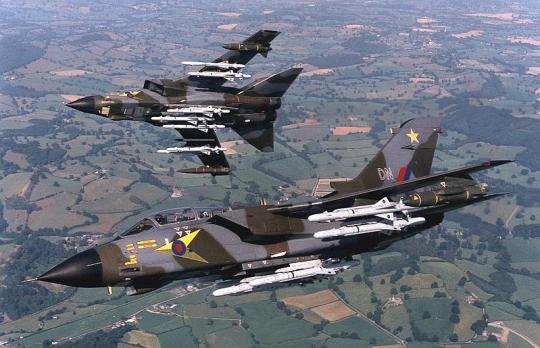
The Tornado ended its long career with the RAF last year. It had been used in wars, virtually without respite, since its combat debut attacking Iraq in 1991. No RAF aircraft fought for so long, and the type is guaranteed to be remembered for a long time, but was it the right aircraft?
The Findus Crispy Pancake munching British public of the 1980s knew their massive air force had a word-beating strike aircraft in the Tornado IDS and a top of the line interceptor in the Tornado ADV. Books and magazines celebrated the amazing potency of the aircraft with almost erotic excitement. Here was an advanced combat aircraft that could penetrate the Warsaw Pact nations’ air defences at treetop height (day or night) in appalling weather, and wreak havoc on their airfields and industrial areas. It was all very exciting, but was it true?
When I interviewed a former RAF Tornado pilot last week, I asked her how she felt the Tornado GR4 compared to the US F-15E Strike Eagle. “It’s a tricky question as emotionally I loved flying the GR4, however it would have been fantastic to fly the F15. Would it have been a better investment for the UK, rather than buying the Tornado? Probably!†She also noted “Let’s be honest, it’s not as capable, apart from having a better range, I think that’s the only category on aircraft Top Trumps that the Tornado would win!â€
When the Tornado was conceptualised in the late 1960s, the priority was high-speed low-level flight and long range. It was intended to fly low enough to avoid effective radar detection and perform deep interdiction missions, pre-emptively destroying strategic targets. It drew on the earlier AFVG and was heavily influenced by the similar, but larger, US F-111. The design was optimised for low-level high speed flight, but as Tornado Gulf Veteran Alistair Byford pointed out: “However, this all comes at the expense of altitude performance, and a war-loaded Tornado struggles to reach half the cruising height of a typical airliner. Clearly this has hindered its subsequent adaptability, and although the Tornado has provided absolutely sterling service and been repeatedly updated to keep it current as a weapons platform, this has been in spite of (rather than because of) its fundamental design and aerodynamic qualities.” The same was true of the sensors “At night the crew were blind to other aircraft resulting in tactics having a heavy reliance on timing that gave little flexibility to evade and safely avoid air and ground contract.”
The Tornado was a brilliantly engineered answer to the wrong question.

Variable geometry came at too large a cost
Variable geometry or ‘swing wings’ were included to meet the requirement for short field performance, long range and high speed flight. The small, heavily-loaded wing area gave the Tornado a very smooth ride at low-level, which both reduced crew exhaustion and made for a steady weapons platform. But it requires a heavy, voluminous and labour-intensive mechanism. The F/A-18 Hornet, a contemporary of the Tornado, is beefed up to allow carrier operations and has an empty weight of 10,433 kg; the Tornado had an empty weight of 13,890 kg. Though conceptually very different aircraft, in reality they ended up performing many similar missions (CAS and precision bombing in general). It is interesting to note that both types suffered from limitations that resulted from the opposite design compromises. The Tornado lacked power and performance; the Hornet lacked range and payload. Regardless, there is a reason that no VG aircraft projects have been initiated since the early 1970s: the advantages are not worth the increase in weight and complexity.
High attrition in Desert Storm
In Desert Storm, against a lesser enemy than the Tornado, which was created to defeat it, it suffered badly. Of the 55 Allied aircraft lost in Desert Storm, 8 were Tornados. Only 48 RAF Tornados were sent. This is pretty bad – consider this: the US alone deployed 1,656 armed aircraft to the campaign. The USAF alone flew 65,000Â sorties, the RAF Tornado force 2,500. Â
Soon after the war reports blamed the JP223* a cluster bomb/land-mine dispenser that ejects dozens of bomblets that required a predictable low-level attack profile, for the high rate of losses. This was only the case for one of the losses (the egress profile not the attack itself causing the loss). This misunderstanding was used to brush aside other observers who noted the alarming loss rate of Tornadoes in the war. Considering the aircraft was intended to be used against the far bigger and more potent Warsaw Pact, the likely losses would have been extreme.
The high number had much to do with the emphasis on low-level flight, the volume of missions and the type of weapons used. Stand-off weapons are now the preferred anti airfield weapon. When the safer US approach of attacks from medium levels was adopted, Tornados were at a disadvantage as they lacked the power to perform effectively at this altitude. Again, the Tornado design was over-specialised. In fairness, the F-15 and F-16 were both extremely specialised in their early life but superb engine/airframe performance allowed them to better adapt to new roles.
In Kosovo in 1999, the aircraft was much improved, but poor weapons integration meant the new precision bombs it was carrying were dangerously inaccurate.
*The use of the JP223 is now illegal under both cluster bomb and landmine conventions. The Convention on Cluster Munitions came into effect in 2010. Countries that have opposed the convention and not joined include China, Russia, the United States, India, Israel, Pakistan, and Brazil.
Self defence
“I would have preferred to see a better air-to-air capability, either through the radar and/or data-linking to the AWACs picture: that and possibly a radar missile would have given the Tornado a better self-defence capability”, Noted Tornado veteran Michael Napier in this interview. Today, mud movers such as the F-15E, Su-34 and the Eurocanards consider these de rigueur features for survival.
Tornado ADV

Yes, the Tornado F.Mk 3 was effective at the end of its career. However, all the good systems integrated onto the F.Mk 3 would have been more effective on an aircraft of higher performance. Again, this is a case of Tornado succeeding in spite, not because, of its design. The ADV’s limitations are well-documented, but they centre around poor agility, poor medium and high-altitude performance, and a painfully slow radar development process.
In exercises towards the end of the 20th century, SkyFlash-armed Tornado F3s did very badly against German F-4Fs equipped with AMRAAMs. Could a F-4F or more radical British Phantom upgrade have proved a more cost- and combat-effective alternative to the F3 in the 1985-1998 timeframe? Almost definitely.
Though the F3 was well equipped at the time of its retirement, it was lacking a helmet cueing system, something which would have helped it where it was most vulnerable, in within visual range engagements with inevitably more agile opponents.
Anti Shipping

“A good maritime radar can pick up the nice big steel and aluminium radar reflector that is a ship at long range. The Buccaneer’s Blue Parrot radar had a maximum range of 240 nautical miles, although 180 was more normally used. The Tornado…had a maximum range of forty nautical miles*. So when operating without a Nimrod the Tornado was limited to firing Sea Eagle well inside the missile’s normal launch range” – Wing Commander Gordon Robertson (retd) in ‘Tornado Boys‘. The Sea Eagle was a big missile and fitting four meant the loss of the main fuel tank pylon, so to ensure an effective radius of action only two were carried, half the load of the aircraft it replaced, the Buccaneer. Considering a Royal Navy study estimated it would take 24 missiles to reliably knock out a large warship, this was a considerable disadvantage.
The engines were more ‘fragile’ than the Bucc’s, the light grey camo scheme made the aircraft stand out like a “sore thumb” over the sea, and worse still, a fleet-wide upgrade from 1998 had introduced a wiring problem to the GR.1B which meant the Sea Eagles didn’t work (in a Exercise Nepture Warrior one crew were allocated two missiles to fire: both failed). The Tornado also had navigation and weapon aiming system issues over the sea.
(*Sea Eagle’s maximum range was around 60NM)
Suppression/Destruction of Enemy Defences
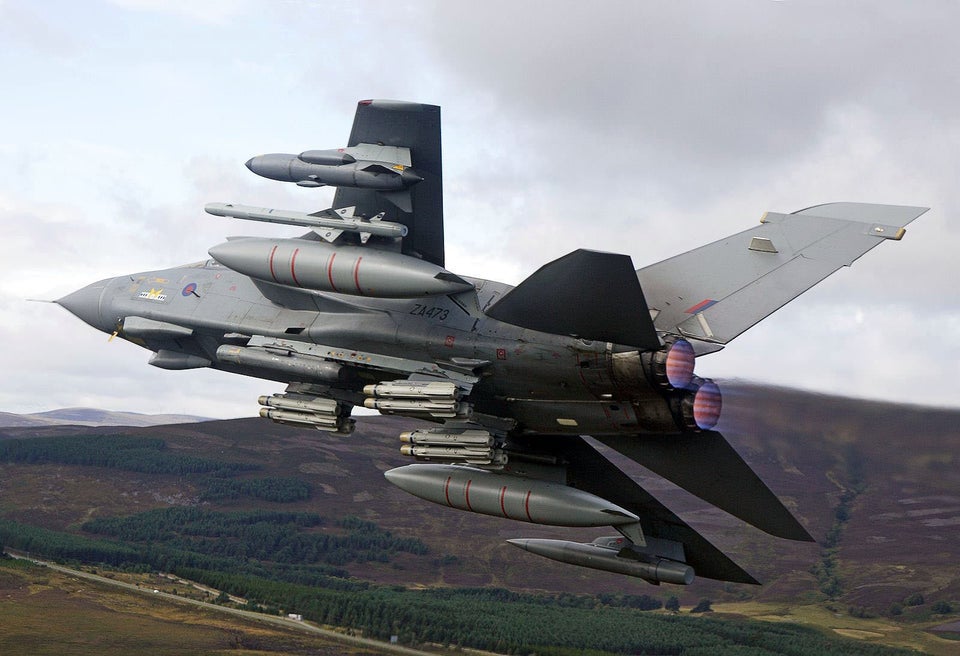
The Tornado was used in the defence suppression role in the 1999 Kosovo campaign. As Wing Commander Gordon Niven (retd) noted in ‘Tornado Boys’, the ALARM missile and Tornado combination was not very effective for the role, “Neither the missiles nor the Tornado was configured in any way remotely close to the capability of the USAF F-16 SEAD units.” The ALARM was used by RAF Tornados from 1990 until 2013, a short service life for a guided anti-radar weapon; the US equivalent, the AGM-88 HARM series, has been in service since 1985 with no planned retirement date. Today an RAF ALARM from the Kosovo campaign is displayed in the Belgrade air museum, it failed to self destruct or destroy a target and instead gently delivered itself by parachute into curious (and Russian-friendly) Yugoslav hands.
Low-level culture
Low-level flying can still be an effective counter to radar, but it is also dangerous. Training for this mission has resulted in more aircraft and crew losses than anything else, including actual warfare, over the last fifty years. The culture is embedded in the RAF, a force that often prides itself on being among the best at this skill. There have been times when a cultural prejudice has favoured low-level tactics over the development of weapons that can be launched from higher altitudes.
The F-117 Nighthawk introduced another radar survival approach into operational service four years after the Tornado: stealth. Today all high-end warplanes in development are baking a high degree of reduced radar conspicuity into their design. The Tornado with its huge metal tail and boxy fuselage was extremely unstealthy. It is also worth noting that Tornado low-level training in Europe emphasised hiding behind hills, a terrain feature that is not available in much of Iraq.
Export success?
Nope. Saudi Arabia bought the IDS. But they will buy anything British, and the deal was shady as hell. In all 2006 all this dodgy-ness was all brushed under the carpet: “The Director of the Serious Fraud Office has decided to discontinue the investigation into the affairs of BAE Systems plc as far as they relate to the Al Yamamah defence contract. This decision has been taken following representations that have been made both to the Attorney General and the Director concerning the need to safeguard national and international security. It has been necessary to balance the need to maintain the rule of law against the wider public interest.”
Alright smart arse, so what should have happened?
IDS
A radical Buccaneer upgrade to cover the role until the arrival of the F-15E. At its peak, the RAF had six squadrons; a greater number (more airframes were available) of Super Buccaneers could have done this job.
ADV
F-4s to cover the role until either the earlier arrival of F-15Cs or a later arrival of dual-role F-15Es.
Political & Industrial
Did the Tornado protect the British aerospace producers from US industrial hegemony? No. The UK is currently procuring the F-35. A deal which has hindered Britain’s ability to create indigenous designs. Did it help to keep Europe together? No.
The roots of at least some of Tornado’s problems lie in a lack of compromise from the British side and the interference of political considerations. As the former West German Chief of Air Staff Heinz Birkenbeil noted in Dr Alfred Price’s ‘Panavia Tornado‘, “Before we went into the programme the German requirement was for a daylight attack plane. All the other European nations and Canada needed a replacement for the F-104, each nation put in its requirements and the requirements were a long way apart. In the second round the British required a deep interdiction aircraft with at least twice as much range as the Germans wanted, and all at low level for strike and conventional attack –– we had wanted an aeroplane for strike and close air support, with an air superiority capability over the battlefield. But we had not been after an aeroplane for deep interdiction… I told our Chief of Air Staff [General Steinhoff] that my department did not think the projected aircraft would fit the german requirement. And then a funny thing happened. The programme was of great political importance to Europe and the politicians stepped in…The result of this in Germany was the Chief of Air Staff simply changed our Air Force’s requirement until it eventually fitted the requirement of the MRCA!”


