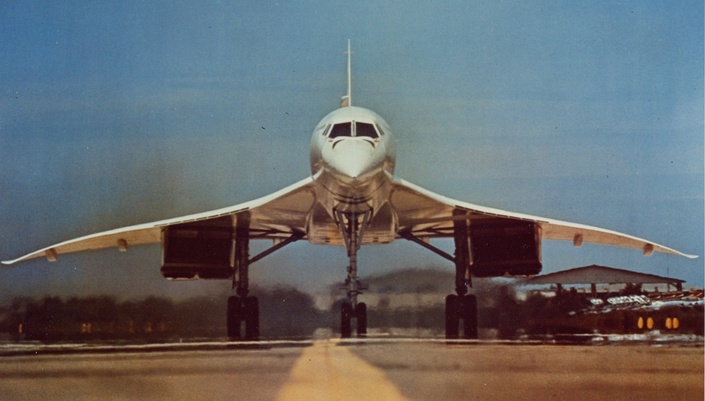
As the most beautiful manmade object celebrates half a century since its first flight, aviation journalist Joe Coles reflects upon the supersonic airliner’s iconic design, and its place in visual culture and the popular imagination.
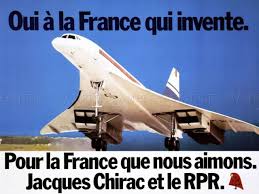
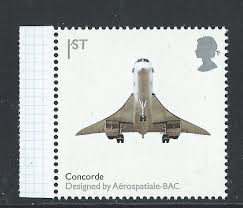


 Europe was uniting, partly as a counter to the economic supremacy of the USA, and the Concorde was the child of a very special friendship between Britain and France. As well as a hope for a more united Europe, it also spoke of a global utopian desire. With the moon landings a few months away, 1969 carried a strong sense of optimism. Boundaries were being broken both technologically and socially, and anything was possible. Concorde was almost a spaceship, and one that anyone rich enough could fly on. Earlier advertising for airliners had compared them to ocean liners, but this was a rocket-ship. Much of the marketing was based on this clean, futuristic image, a probing, heroic machine in empty skies. Far from the egalitarian vision of cheap, mass air travel delivered by the Boeing range, the Concorde experience was elitist and extremely expensive. Considering the huge operating costs, it had to be. Champagne, lobster, caviar and foie gras delivered by immaculately dressed stewards made Concorde the highest, fastest, high-class restaurant in the world. The creation of advanced aeroplanes is a very conspicuous way to wave the flag. Though its cultural exports were booming in the 1960s (notably music and fashion), Britain’s earlier position as leader in the automotive and aeronautical industries was on the wane.
France’s, meanwhile, was on the rise. Civil aviation is historically dependent on military research, and as Britain’s military aircraft manufacturing shrunk, its civil industry followed suit. Britain had produced the first jetliner, the beautiful Comet, in 1947, but now America had almost complete market dominance. Since the mid-1940s the US had usurped Britain and Germany as the most technologically advanced nation. The Anglo-French Concorde was a bold counter-attack from Europe. Concorde was twice as fast as any other operational airliner in 1969, and this remains true today. Though the Soviet equivalent, the Tupolev Tu-144 (nicknamed the ‘Concordski’), had beaten the Concorde into the air by a matter of weeks, this inferior rival would ultimately fail, leaving the Concorde as the only successful supersonic jetliner. Its US rival, the Boeing 2707, though bigger and faster, proved so expensive and technically daunting it was canceled before it flew. With the nascent 747, the US was now betting the farm on size and efficiency, while Europe was rooting for speed and luxury. Though it first flew in the 1960s and found fame in the 1970s, the Concorde’s roots lay in the 1950s, and in many ways it represented the ultimate ‘50s vision of the future. Until 1969, progress had a close relationship with speed: technology gave us faster trains, cars, ships and aeropalnes. With Concorde, and military aircraft generally, speed came up against practicality — was it necessary to go any faster? Market forces said ‘no’. In 1969, the F-4 fighter had a top speed of Mach 2.2. Today, the US’ most advanced fighter, the F-35, can reach Mach 1.6. In 1969, Concorde could exceed Mach 2, in 2019 the fastest airliner cannot achieve Mach 1. Simply put, aeroplanes stopped getting faster in 1969.
Europe was uniting, partly as a counter to the economic supremacy of the USA, and the Concorde was the child of a very special friendship between Britain and France. As well as a hope for a more united Europe, it also spoke of a global utopian desire. With the moon landings a few months away, 1969 carried a strong sense of optimism. Boundaries were being broken both technologically and socially, and anything was possible. Concorde was almost a spaceship, and one that anyone rich enough could fly on. Earlier advertising for airliners had compared them to ocean liners, but this was a rocket-ship. Much of the marketing was based on this clean, futuristic image, a probing, heroic machine in empty skies. Far from the egalitarian vision of cheap, mass air travel delivered by the Boeing range, the Concorde experience was elitist and extremely expensive. Considering the huge operating costs, it had to be. Champagne, lobster, caviar and foie gras delivered by immaculately dressed stewards made Concorde the highest, fastest, high-class restaurant in the world. The creation of advanced aeroplanes is a very conspicuous way to wave the flag. Though its cultural exports were booming in the 1960s (notably music and fashion), Britain’s earlier position as leader in the automotive and aeronautical industries was on the wane.
France’s, meanwhile, was on the rise. Civil aviation is historically dependent on military research, and as Britain’s military aircraft manufacturing shrunk, its civil industry followed suit. Britain had produced the first jetliner, the beautiful Comet, in 1947, but now America had almost complete market dominance. Since the mid-1940s the US had usurped Britain and Germany as the most technologically advanced nation. The Anglo-French Concorde was a bold counter-attack from Europe. Concorde was twice as fast as any other operational airliner in 1969, and this remains true today. Though the Soviet equivalent, the Tupolev Tu-144 (nicknamed the ‘Concordski’), had beaten the Concorde into the air by a matter of weeks, this inferior rival would ultimately fail, leaving the Concorde as the only successful supersonic jetliner. Its US rival, the Boeing 2707, though bigger and faster, proved so expensive and technically daunting it was canceled before it flew. With the nascent 747, the US was now betting the farm on size and efficiency, while Europe was rooting for speed and luxury. Though it first flew in the 1960s and found fame in the 1970s, the Concorde’s roots lay in the 1950s, and in many ways it represented the ultimate ‘50s vision of the future. Until 1969, progress had a close relationship with speed: technology gave us faster trains, cars, ships and aeropalnes. With Concorde, and military aircraft generally, speed came up against practicality — was it necessary to go any faster? Market forces said ‘no’. In 1969, the F-4 fighter had a top speed of Mach 2.2. Today, the US’ most advanced fighter, the F-35, can reach Mach 1.6. In 1969, Concorde could exceed Mach 2, in 2019 the fastest airliner cannot achieve Mach 1. Simply put, aeroplanes stopped getting faster in 1969.


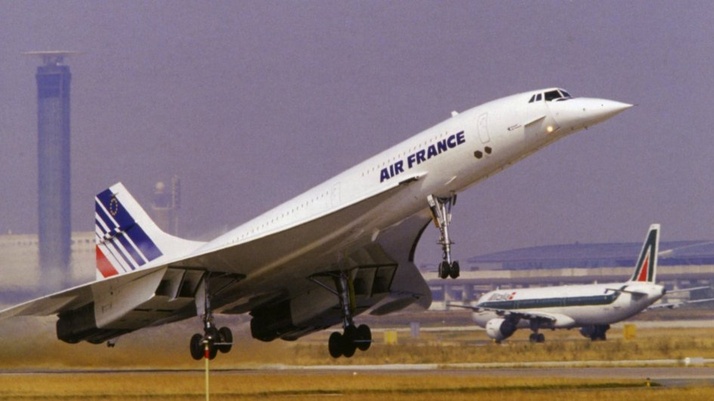 Concorde’s shape sold itself, as mentioned, the power of Concorde is largely in the mind, and equally emotive to onlookers as to passengers. The wing is the most visible symbol of flight, had Concorde’s been a simple straight-edged triangle it would have communicated speed and aggression. However, the addition of curves on Concorde’s iconic wing added a unique sensuality; the future was fast, but it was also elegant. Design was once satirically described as the art of adding curves, by this measure Concorde was a masterpiece. This sophistication was clearly a marketing coup, with many on both sides of the Atlantic entertaining the idea of Europe as being more ‘sophisticated’ than America, a nation that some saw as a brash new upstart.
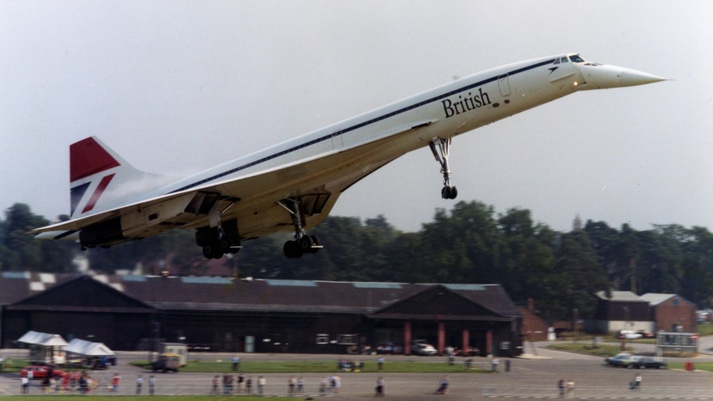 Air France’s branding led the way with an appropriately modern appearance for both the exterior and interior of the aircraft. British Airways was a little slower, but the company’s radical 1984 revamp transformed the Concorde brand. The new look moved away from staid, patriotic Britishness to a fresher, and swifter, present. Gone was the old-fashioned typeface that had declared ‘British’ across the forward fuselage in a seriffed, curved and rather imperial style, replaced with a bold but smaller all caps ‘British Airways’. The famous, blue ‘Speedbird’ motif that ran the length of the fuselage was superseded by a more dynamic, red ‘Speedwing’. Whereas the older look was one of national confidence and a pride in the past, the new image whispered high velocity, style and refined luxury. In 1997, British Airways enjoyed another, arguably less popular, rebranding. The geometrically tidy national colours on the tail become a wavy, irregular ‘fluttering banner’. The Speedwing was replaced with a smaller ribbon known as the ‘Speedmarque’. This lighter look, though less authoritarian, was Concorde’s blandest scheme. Yet despite this, Concorde never grew boring, and it was a sad occasion when the type was retired in 2003, a mere 27 years after the aircraft was introduced to commercial service. It died a champion and in its absence the world slowed down.
 Key to Concorde’s iconic mystique was its failure. Though technologically it was a resounding success, it was a commercial disappointment: a mere twenty were built, which is a tiny amount when compared to its contemporary, the larger Boeing 747, of which over 1,500 have been produced (and continue to be produced in 2019). Though at times Concorde was profitable, it was expensive to operate and maintain — and this become starkly apparent in its final years. This meant its unusual shape was always special, always identifiable. Familiarity breeds contempt, but Concorde remained gloriously special to the end.
The original version of this article can be seen here with wonderful imagesÂ
Key to Concorde’s iconic mystique was its failure. Though technologically it was a resounding success, it was a commercial disappointment: a mere twenty were built, which is a tiny amount when compared to its contemporary, the larger Boeing 747, of which over 1,500 have been produced (and continue to be produced in 2019). Though at times Concorde was profitable, it was expensive to operate and maintain — and this become starkly apparent in its final years. This meant its unusual shape was always special, always identifiable. Familiarity breeds contempt, but Concorde remained gloriously special to the end.
The original version of this article can be seen here with wonderful imagesÂ