
—original article removed at author’s request—
Next year will be the centenary of the formation of the RAF, leading to all kinds of celebrations of the service’s history, no doubt. The Battle of Britain, the dam busters raid, Black Buck…what you probably won’t hear is anyone arguing for the RAF to be disbanded. Which is a shame. Despite all the achievements, the time has definitely come to admit that the ‘indivisibility of air power’ is no longer relevant, if it ever was, and that there’s no reason for the RAF to exist any more – if there ever was.
So why now? The fact is that without a genuinely strategic role that only an independent air force can carry out, having such an independent air force is pointless and wasteful. The RAF currently exists to do a number of jobs – tactical strike on the battlefield, supporting the Navy at sea, carting stuff around, and spying on things. Since it lost the strategic nuclear deterrent role back in the 1960s, there is nothing the RAF does that has to be done by an independent air force.
It’s worth looking at why the RAF was created in the first place. With the First World War gearing up for a final showdown on the Western Front, most of the UK’s air power was focussed on that theatre. The Royal Naval Air Service had done so well with its resources that it had been roped in to support the Royal Flying Corps – whose job was largely to support the Army on the ground. The RNAS had developed air power arguably more innovatively and completely than the RAF – the RNAS was the first British air arm to develop strategic bombing with large, multi-engined aircraft, and many of the best British designs for engines and aeroplanes (such as the Sopwith Pup, Triplane and Camel, the Airco DH4 and the Bentley BR1 rotary) originated from Admiralty requirements. In the context of the climax of the land war in Europe, it made sense to combine these forces and put them under single command.
But this was only supposed to be a temporary arrangement, and with the end of the war and drastic reductions to forces, there was no reason other than politics to retain the single air force. Lord Trenchard, the RAF’s main cheerleader in government (who had only been offered the post as the result of a political spat between Lord Rothermere and Field Marshal Haig) quickly sought to find a way to make the RAF indispensible. He came up with ‘air control’ – a method of policing the far-flung territories of the British Empire from the air. This was initially thought to be effective (in reality it just tended to push trouble from one place to another, and created simmering resentment among people being bombed and strafed as well we exploited) but the main advantage was that it was much cheaper than using the Army. Trenchard fought off an effort in the early 1920s to give the Navy control of its own aviation, so withered had it already become under RAF control. Had this been successful, the Army would likely have also been given command of land based forces, and the RAF wound up. Unfortunately, Trenchard had the politicians’ ears still.
Ever since, the RAF’s greatest success has been its continual ability to magic up jobs that only it can do, and persuade politicians of its unique ability to do them. The fact that it has had to do this at the expense of military aviation in other areas is constantly overlooked. By the beginning of WW2, Army Co-operation was eroded from the huge, complex operation of WW1 into a few squadrons of ridiculous Westland Lysanders which were shot to bits over France, and it took the rest of the war to build up a truly effective tactical air force that would have made more sense being under Army command in any case.
Even now the Army has had to put up with arbitrary limitations on the size of the helicopters it can operate because the RAF has persuaded Whitehall that anything bigger than a Lynx should be under its management. No other country has to work with this pointless and ludicrous division, and the UK should not have to any longer. It was long ago accepted that both the Army and the Navy need their own aviation divisions, in itself rendering much of the argument for an independent air force null and void.
The RAF has repeatedly knocked down naval aviation, leaving the Royal Navy to endlessly re-learn old lessons and make do on a shoestring, effectively killing or hamstringing naval air arms repeatedly since the First World War. The decision to kill the Harrier – conveniently the only fast jet that could operate from the Navy’s carriers – instead of the Tornado, and the Nimrod instead of the A400M in 2010 were merely the latest manifestations of this, and rumours abound that the RAF’s malign influence in the MoD continues to hamper the ailing CVF/Joint Combat Aircraft programme.
There are undoubtedly things the current RAF does well, such as tactical airlift. This is not an argument for retaining the RAF, merely for retaining the skills, personnel and organisation that currently make the function work. It could just as easily be transferred to the Army, as could the land-based fast jet force. The transfer of all the Merlin Mk.3 fleet to the Royal Navy shows that it is perfectly possible to divest the RAF of parts of its portfolio without harming effectiveness – so why not do so with the whole RAF? There is nothing the RAF currently does that would not be done as well or better under Army or Navy control, and it would end at a stroke the 100 years of politicking that has compromised UK forces too much. RAF – RIP.
— Mark Taunton
“If you have any interest in aviation, you’ll be surprised, entertained and fascinated by Hush-Kit – the world’s best aviation blogâ€. Rowland White, author of the best-selling ‘Vulcan 607’
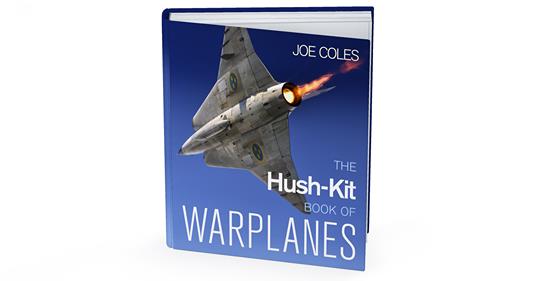
I’ve selected the richest juiciest cuts of Hush-Kit, added a huge slab of new unpublished material, and with Unbound, I want to create a beautiful coffee-table book. Pre-order your copy now right here Â
TO AVOID DISAPPOINTMENT PRE-ORDER YOUR COPY NOW

From the cocaine, blood and flying scarves of World War One dogfighting to the dark arts of modern air combat, here is an enthralling ode to these brutally exciting killing machines.
The Hush-Kit Book of Warplanes is a beautifully designed, highly visual, collection of the best articles from the fascinating world of military aviation –hand-picked from the highly acclaimed Hush-kit online magazine (and mixed with a heavy punch of new exclusive material). It is packed with a feast of material, ranging from interviews with fighter pilots (including the English Electric Lightning, stealthy F-35B and Mach 3 MiG-25 ‘Foxbat’), to wicked satire, expert historical analysis, top 10s and all manner of things aeronautical, from the site described as:
“the thinking-man’s Top Gear… but for planes”.
The solid well-researched information about aeroplanes is brilliantly combined with an irreverent attitude and real insight into the dangerous romantic world of combat aircraft.
FEATURING
-
-
-
- Interviews with pilots of the F-14 Tomcat, Mirage, Typhoon, MiG-25, MiG-27, English Electric Lighting, Harrier, F-15, B-52 and many more.
- Engaging Top (and bottom) 10s including: Greatest fighter aircraft of World War II, Worst British aircraft, Worst Soviet aircraft and many more insanely specific ones.
- Expert analysis of weapons, tactics and technology.
- A look into art and culture’s love affair with the aeroplane.
- Bizarre moments in aviation history.
- Fascinating insights into exceptionally obscure warplanes.
-
-

The book will be a stunning object: an essential addition to the library of anyone with even a passing interest in the high-flying world of warplanes, and featuring first-rate photography and a wealth of new world-class illustrations.

Rewards levels include these packs of specially produced trump cards.


Pre-order your copy now right here Â
I can only do it with your support.

