

What was the best fighter of World War II? The evolution of fighters in this period was a Darwinian bloodbath that would have had Richard Dawkins slavering with excitement. Whatever we put in this list some numb-nut or another will have different ideas. Here’s our selection, the order they appear is, more or less, totally arbitrary (apart from number 1 which we firmly believe WAS the best fighter of the war). Enjoy!
Keep this blog alive!
To keep this blog going- allowing us to create new articles- we need donations. We’re trying to do something different with Hush-Kit: give aviation fans something that is both entertaining, surprising and well-informed. Please do help us and click on the donate button above – you can really make a difference (suggested donation £10). You will keep us impartial and without advertisers – and allow us to carry on being naughty. Once you’ve done that we hope you enjoy 10 Incredible Soviet fighter Aircraft that never entered service. A big thank you to all of our readers.
10. Steamboat Fattie: Grumman F6F ‘Hellcat’

The Hellcat was ordered as an alternative in the event of any major problems with the F4U Corsair, which was very prudent as the Corsair programme very quickly ran into very major problems indeed, and the sturdy F6F found itself the premier carrier fighter in the World’s mightiest carrier fleet. The Hellcat was big, heavy and extremely powerful, the very antithesis of its major opponent, the A6M Zero.
To fight the Zero, pilots of earlier Allied naval fighters had had to develop inventive tactics to deal with the superior Japanese aircraft. With the coming of the Hellcat, the US Navy had a fighter that was slightly faster, better armed and just manoeuvrable enough to deal with the Japanese fighter. Plus it was extremely strong and easy to fly, factors which saved many a pilot who would have been doomed in any other aircraft. The Japanese advance had been checked by the Wildcat, but it was the chunky Hellcat that allowed the US Navy to win the war in the Pacific before being replaced (in part by its old nemesis the Corsair) right at war’s end. It was exactly the right aircraft at exactly the right time.
9. ‘Dear Little Cobra’ Bell P-39 Airacobra

When the P-39 first flew it had a turbo-supercharger and was a fantastic performer at all altitudes. However the US Army Air Corps decided that no fighter would ever be required to operate at high altitude so they removed the turbo-supercharger and developed the P-39 into a low altitude fighter par excellence. Then, when it was committed to combat the same US Army Air Corps were scathing in their criticism of the P-39’s altitude performance and called it ‘especially disappointing’. A bit rich you might think seeing as they were the ones who had cacked it up in the first place.
Thus the unwanted Airacobra was sent by the thousand to the Soviet Union where it found itself in a battlefield where virtually all combat was at low level and its capabilities could be properly appreciated. It was fast (a P-39 won the first post war American air-race), it handled beautifully, it was tough, its tricycle undercarriage was perfect for rough field operations, and its firepower was nothing short of spectacular. Of the six Soviet pilots to score more than 50 kills, four flew the P-39. Its performance was superior to the German aircraft it faced (and the Soviet aircraft it complemented). The Airacobra gained more air to air kills than any other US built fighter and demonstrated the remarkable strategic wisdom of the Lend-Lease programme. Given that the Eastern Front used up 80% of the German war effort, the Kobrastochka could reasonably be considered the most important American fighter of the war in Europe.
8. Cheap and Deadly: Messerschmitt Bf 109

When studying military aircraft there is one aspect of design receives barely any attention, yet at the time is often the most important of all, namely: cost. The 109 was, arguably, the best fighter in the world from the time of its introduction until 1942(ish) despite being, according to an aircraft restoring engineer friend of mine ‘a pile of shit’Â from a construction point of view. However, it was also very cheap and it was this aspect that led to it becoming the most produced fighter ever (or second most produced, depending on your criteria: see below). Even once its developmental zenith was past it represented a potent foe and was never outclassed by its opponents. The 109 scored more air-to-air kills than any other aircraft before or since and probably represents the best value for money of any fighter in history. Try saying that about the F-22.
7. The Triumph of Socialist Labour Yakovlev Yak-1 to 9

When the great Soviet ace Alexander Pokryshkin was being pressured for political reasons to convert his unit to a Soviet built aircraft rather than the Airacobra he was then flying (to great effect), one of the proffered types was the Yak-3. Pokryshkin personally detested Alexander Yakovlev and refused the offer of his latest fighter. This is unfortunate as by doing so Pokryshkin cheated himself out of flying the finest Soviet fighter of the war. The French Normandie-Niemen unit, who fought as part of the Red Army had rather a different opinion. At the end of the war they were (allegedly) offered their choice of any Allied fighter aircraft and they selected the Yak-3. Marcel Albert, their top scorer, maintained that the Yak could outclimb a Spitfire and had a higher cruising speed. The Yak-3 was one of a family of fighters that began with the Yak-1 and diversified into different lines of concurrent development. Despite their different designations there was less difference between the types than between an early and late model Messerschmitt 109 which adds weight to the suggestion that the Yak family as a whole can be considered to be the most manufactured fighter of all time as around 38000 were built in total. The Yak-3 was the lightest and smallest fighter to be used in numbers by any combatant during the war and this led to its remarkable performance on a relatively low-powered engine. Despite its daintiness the Yak-1 was on a par with contemporary Bf 109 and Fw 190 models and by war’s end was comfortably superior to both. Unburdened with the extraneous equipment deemed necessary in the West, the Yak was a very pure sort of fighting machine and probably the most pleasing aircraft from a pilot’s perspective of the war. And what other first-line 1940s fighter has had production restart for the civilian market in the 1990s or been modified into a basic trainer?
6. I could have been a contender! Fiat G.55

Just before everything went completely awry for the Italians they managed to obtain a supply of the latest DB 605 engines from Germany and built three superb fighter types. All three saw service but the best was the Fiat G.55, indeed it was so good that a team of German experts (including Adolf Galland) came to the conclusion that it was the best fighter in the Axis, possibly the world, and should be produced in vast numbers immediately for German use. Kurt Tank, designer of the Fw 190 had nothing but praise for the G.55 either and went to Turin to look at its potential for mass-production. Sadly for the Axis cold hard economic logic came into play and when it was pointed out that the, admittedly outstanding, Fiat took 15000 man hours to build against the 5000 of the still formidable Bf 109, production plans were quietly abandoned. Thus, less than 300 of the Axis’s best fighter were built and saw service only in a backwater of the conflict for a Nazi client state, whereas some 35000 109s swarmed all over Europe. However, in contrast to so many potentially terrific might-have-beens of the war, the Fiat did at least see production and served in combat, and its brilliance was demonstrated rather than merely conjectured.
5. Shatterer of Self-delusion Mitsubishi A6M Reisen ‘Zero’

Quick quiz question: What links the M16 assault rifle and the Mitsubishi Zero? That’s right: 7075 aluminium alloy. It is used for the upper and lower receivers of the M16 and it was used for most of the structure of the Zero. First produced in 1936 by Sumitomo Metals of Japan and excitingly named ‘extra super duralumin’ at the time, 7075 is an alloy of aluminium and zinc and is significantly lighter and stronger than other aluminium alloys produced until this date. That Jiro Horikoshi, designer of the A6M, had to resort to new technology at the metallurgical level demonstrates not only how challenging the Navy’s specification for their new fighter was (Nakajima didn’t even enter a tender, as they deemed it impossible) but also how cutting edge the Zero was – even at the molecular level.
At its debut the A6M was the World’s best carrier fighter. That this fact was totally ignored by the Allies, despite the aircraft being, quite openly used over China in strength, suggests that the West was all to willing to believe its propaganda on Japanese military capabilities. Propaganda that today seems, at best, laughably naive, at worst founded on an illusion fostered by dogged racism. Whatever the truth, the Zero changed all that, and with such total dominance, that it gave rise to a belief in Japanese invincibility in the minds of its opponents that would remain unchecked for the first year or two of the Pacific war. By the time American fighter design had caught up a bit, grubbily specious claims were invented to ‘explain’ the Zero’s remarkable design and performance, for example Howard Hughes claimed post-war that Mitsubishi had copied his H-1 racer, and Eugene Wilson (president of Chance-Vought) claimed they had copied Vought’s own (mediocre) V-143 fighter. It is bizarre that industrialists should resort to lying about an enemy aircraft (‘we designed it really!’) in a war already won but does demonstrate the absolute superiority that the Zero demonstrated and just how infuriating that was to the grandees of the US Military-industrial complex. Praise indeed.
4. Man Machine Interface Focke Wulf Fw 190

Quite apart from being an excellent aircraft with several radical features, the Fw 190 heralded a revolution in what today would be called ‘ergonomics’ but in 1941 was basically an unknown concept. Today the concept of HOTAS (hands on throttle and stick) is well-known and is generally considered to have been pioneered by the F-16. However the 190 sported a system that delivered the HOTAS concept some thirty years earlier. Known as the Kommandogerat, it was a remarkable device that automatically controlled fuel flow, fuel mixture, propellor pitch and ignition timing. It also activated the supercharger at the correct altitude – all the pilot had to do was move the throttle lever. His other hand was on the control column, where all the armament controls were situated, allowing his full awareness to be directed to combat. This situational awareness was further enhanced by the bubble hood (from which the view as described by a contemporary RAF report ‘is the best that has yet been seen’). When one considers that on its debut the Fw 190 was superior in every performance parameter except turn rate to its closest rival, the Spitfire V, yet also gave its pilots a tactical edge due to reduced workload, it is no wonder that its very existence sent British designers into a frenzy of activity to try and regain ascendancy. The Spitfire and other fighters later achieved parity but the Fw 190 remained a dangerous opponent, and like the F-16, saw its main role shift to a greater emphasis on the fighter bomber role. An aircraft that defined the state of the art, the Fw 190 could be the first truly modern fighter.
3. My Little Pony North American P-51 Mustang

Because everyone’s been going on about how incredibly fantastic the Mustang for years and years it tends to distract attention from what a truly remarkable aircraft it was. It is worth remembering that it shouldn’t have existed at all and came about solely because North American didn’t particularly want to build P-40s for the British. Even then, it would have remained a competent but hardly spectacular improvement on the Curtiss fighter had not some bright spark suggested fitting a Merlin engine in it (curiously this step was taken independently and near simultaneously by North American in the US and Rolls-Royce in the UK). Even then, many pilots were initially less than impressed, citing the finer flying characteristics of the Spitfire and the better manufacturing quality of the P-47. But the Mustang was at least as good a fighter as either and could fly to Berlin and back. “When I saw those Mustangs over Berlin, I knew that the war was lost” said Herman Goering and he was right. Whether or not it was the best fighter of the war, the Mustang invariably remains the standard against which other hopefuls are judged.
2. Myth-maker Supermarine SpitfireÂ

Today if you ask people what a ‘spitfire’ is, virtually everyone (in the UK at least) will say ‘an aeroplane’. It is extremely unlikely that anyone would say ‘a person with a fierce temper’ despite the slightly tedious accuracy they would be demonstrating if they did. This is the enduring legacy of the Spitfire, it has become the definition of the word originally used to name it: its success has changed language. There is only one other aircraft I can think of that has done this and that was Concorde (which is the French spelling of that word anyway). In a similar fashion the Spitfire also changed history, not in the conventional sense that it was important within history (though of course this is also the case), but that the legend of what happened gives it the starring role when reality saw it, (at its finest hour) performing as the supporting player. But who cares? The story is better this way, the dumpy Hurricane relegated to being championed by boring aviation geeks while the eternally handsome Spitfire swans about oozing the sex appeal that any self-respecting fighter aircraft should have. Just look at it. What were they thinking? Legend has it that RJ Mitchell said of the wings “I don’t give a bugger whether it’s elliptical or not, so long as it covers the guns”, but every other fighter covered its guns pretty effectively without cladding them in a difficult-to-manufacture but aesthetically lovely shape so I suspect he was lying. Added to this is the fact that the Spitfire is the only British fighter to be in production for the duration of the war and comfortably remained as one of the top five or so fighters worldwide throughout that time. The Spitfire may also have achieved the highest speed ever attained by a piston driven aircraft, which is pretty exciting. But the Spitfire doesn’t need facts – its claim to being a contender for the best fighter of the war has nothing to do with tawdry reality and everything to do with the myth. The Spitfire has become its own legend (If I hear the word ‘legend’ used in connection with the Spitfire again, I’m docking your pocket money, Ed.)
1. The Harbinger: Messerschmitt Me 262

There was quite a lot wrong with the Me 262 when it was committed to action but most of this was due to the exigencies of the time and had nothing to do with the astounding technological advance it represented when it was unleashed on an unsuspecting world in the spring of 1944. The obvious advantage of its new powerplant was velocity. Once airborne, no other aircraft could catch the speedy Messerschmitt, not even the Allies’ jet, the Meteor, whose performance was decidedly pedestrian by comparison. But it was not solely its jet engines that made the 262 so formidable, its firepower, epitomised for bomber destruction, was particularly heavy consisting of four 30-mm cannon firing explosive rounds at an extremely high rate. The 262 was also in some senses a remarkably practical aircraft for the not-particularly-advantageous situation into which it was introduced. It could be fuelled by a much lesser quality of fuel than its piston-engined brethren so there was more chance of being able to operate it in oil-starved Germany, furthermore a surprisingly large amount of the airframe was made of wood rather than ever more scarce aluminium and steel. Scarcity of steel was the main cause of its major problem – the engines were notoriously short-lived. The Jumo 004 jet engine was not actually a bad design but steel of sufficiently high quality was no longer available for the turbines. It is also worth remembering that these engines, as well as the airframe, were built by slaves so it is hardly surprising that build quality was not that great, in fact it’s remarkable that it worked at all. But even with these niggles the 262 reigns supreme as an incredible technological last-gasp at the end of a war already lost. Its very existence heralded a new age in fighter design of which, in 1945, it was the sole example, it was as if it had popped up from the future to astound and astonish. There is evidence that it may have even broken the sound barrier. The Messerschmitt 262 was in a class of its own. Not bad for an aircraft that was supposed to be a bomber.
Thank you for reading Hush-Kit. Our site is absolutely free and we have no advertisements. If you’ve enjoyed an article you can donate here– it doesn’t have to be a large amount, every pound is gratefully received. If you can’t afford to donate anything then don’t worry.
At the moment our contributors do not receive any payment but we’re hoping to reward them for their fascinating stories in the future.
What was the most combat effective piston-engined fighter ever made? An analysis can be found here.
You may also enjoy top WVR and BVR fighters of today, an alternate history of the TSR.2, an interview with a Super Hornet pilot and a Pacifist’s Guide to Warplanes. Want something more bizarre? The Top Ten fictional aircraft is a fascinating read, as is the The Strange Story and The Planet Satellite. The Fashion Versus Aircraft Camo is also a real cracker.
Follow my vapour trail on Twitter: @Hush_kit
If you enjoyed this have a look at the Ten most formidable piston-engined fighters
“If you have any interest in aviation, you’ll be surprised, entertained and fascinated by Hush-Kit – the world’s best aviation blogâ€. Rowland White, author of the best-selling ‘Vulcan 607’
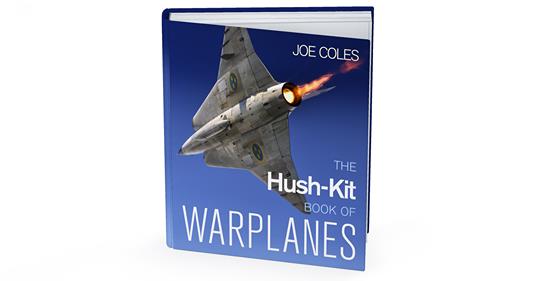
I’ve selected the richest juiciest cuts of Hush-Kit, added a huge slab of new unpublished material, and with Unbound, I want to create a beautiful coffee-table book. Pre-order your copy now right here Â
TO AVOID DISAPPOINTMENT PRE-ORDER YOUR COPY NOW

From the cocaine, blood and flying scarves of World War One dogfighting to the dark arts of modern air combat, here is an enthralling ode to these brutally exciting killing machines.
The Hush-Kit Book of Warplanes is a beautifully designed, highly visual, collection of the best articles from the fascinating world of military aviation –hand-picked from the highly acclaimed Hush-kit online magazine (and mixed with a heavy punch of new exclusive material). It is packed with a feast of material, ranging from interviews with fighter pilots (including the English Electric Lightning, stealthy F-35B and Mach 3 MiG-25 ‘Foxbat’), to wicked satire, expert historical analysis, top 10s and all manner of things aeronautical, from the site described as:
“the thinking-man’s Top Gear… but for planes”.
The solid well-researched information about aeroplanes is brilliantly combined with an irreverent attitude and real insight into the dangerous romantic world of combat aircraft.
FEATURING
-
-
-
- Interviews with pilots of the F-14 Tomcat, Mirage, Typhoon, MiG-25, MiG-27, English Electric Lighting, Harrier, F-15, B-52 and many more.
- Engaging Top (and bottom) 10s including: Greatest fighter aircraft of World War II, Worst British aircraft, Worst Soviet aircraft and many more insanely specific ones.
- Expert analysis of weapons, tactics and technology.
- A look into art and culture’s love affair with the aeroplane.
- Bizarre moments in aviation history.
- Fascinating insights into exceptionally obscure warplanes.
-
-

The book will be a stunning object: an essential addition to the library of anyone with even a passing interest in the high-flying world of warplanes, and featuring first-rate photography and a wealth of new world-class illustrations.

Rewards levels include these packs of specially produced trump cards.


Pre-order your copy now right here Â
I can only do it with your support.

